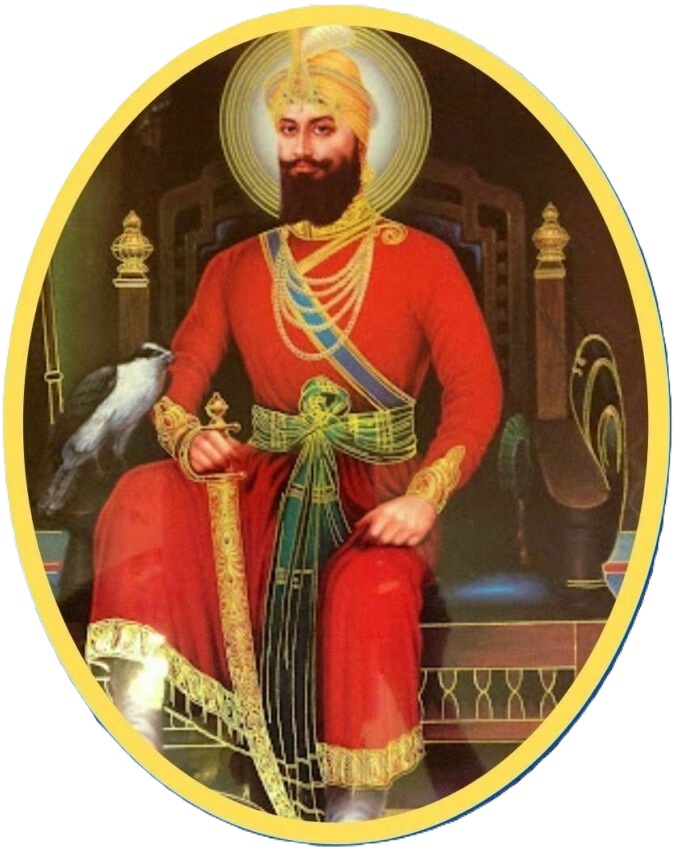
Guru Gobind Singh Ji
Kalgidhar Patshah, who created the Khalsa and gave his all for dharam
- Parkash
- 22 December 1666 (Poh Sudi 7, Samvat 1723); observed on 5 January in the Nanakshahi calendar
Patna Sahib, Bihar (the haveli of Salis Rai Johri, now Takht Sri Harimandir Ji Patna Sahib) - Gurgaddi
- 11 November 1675 (Maghar Sudi 5, Samvat 1732), the day of Guru Tegh Bahadur Ji's Shaheedi; observed on 24 November in the Nanakshahi calendar. Guru Tegh Bahadur Ji had nominated him on 8 July 1675 before leaving Anandpur, and the formal ceremony with Baba Ram Kaur (later Bhai Gurbakhsh Singh) of Baba Buddha Ji's lineage took place at Anandpur on 29 March 1676
Anandpur Sahib (Chakk Nanaki) - Joti Jot
- 7 October 1708 (Katak Sudi 5, Samvat 1765); observed on 21 October in the Nanakshahi calendar
Nanded (Abchal Nagar), on the Godavari, Maharashtra - Takht Sachkhand Sri Hazur Sahib - Guruship
- 1675–1708
Jeevni (Life Story)
Sri Guru Gobind Singh Ji was born at Patna on 22 December 1666 (Poh Sudi 7, Samvat 1723) in the haveli of Salis Rai Johri, where Takht Sri Harimandir Ji Patna Sahib now stands. His father, Sri Guru Tegh Bahadur Ji, was then preaching in Bengal and Assam, and the child was named Gobind Rai by Mata Gujri Ji under the care of his maternal uncle Kirpal Chand. He spent his first years in Patna, loved by the whole city; the Rani of Raja Fateh Chand Maini, childless, took him as her own son, and the Pandit Shiv Dutt, meditating on the Ganga, saw in the playful boy the vision he had long sought. The Sikhs of Patna remember the stories of the child Gobind Rai with the same affection as the Sikhs of Talwandi remember the child Nanak. In 1670 Guru Tegh Bahadur Ji, returning from Assam, met his son for the first time and sent the family towards the Punjab; after a halt at Lakhnaur near Ambala they reached Chakk Nanaki, the town the Ninth Master had founded, in 1672. There the boy was taught Gurmukhi, Persian and Sanskrit, horsemanship, archery and swordsmanship, and grew up amid the sangats of the Shivalik foothills.
He was nine years old when the Kashmiri Pandits came to Anandpur in May 1675, and it was his word that his father accepted as the word of God: who was worthier than the Guru himself to make the sacrifice the hour demanded? Guru Tegh Bahadur Ji nominated him Guru on 8 July 1675 and left for Delhi three days later. On 11 November 1675 the Ninth Master attained Shaheedi at Chandni Chowk, and on 16 November Bhai Jaita brought the sacred head to Anandpur, where the young Guru received it and cremated it with his own hands. Gobind Rai was now the Tenth Master. Baba Ram Kaur of Baba Buddha Ji's line performed the installation ceremony on 29 March 1676, and the boy Guru, supported by Mata Gujri Ji, his uncle Kirpal Chand and the devoted Sikhs of his father's court, began to prepare himself and the Panth for the struggle that lay ahead. He was married on 21 June 1677 to Mata Jito Ji at Guru Ka Lahore near Anandpur, and on 4 April 1684 to Mata Sundari Ji. In 1684 he installed at Anandpur the great war drum Ranjit Nagara, whose beat alarmed the neighbouring hill chiefs, and he began to collect arms, horses and men.
In 1685 Raja Medini Prakash of Sirmur invited Guru Sahib to his territory, and on the bank of the Yamuna Guru Sahib founded the town of Paonta Sahib, where he stayed for three years. These were years of poetry and scholarship: Guru Sahib composed Jaap Sahib, Akal Ustat and parts of Krishan Avtar, gathered fifty-two poets and scholars at his court, had the Sanskrit classics translated into Braj, and held nightly diwans of Kirtan and poetry by the river. Here Sahibzada Ajit Singh Ji was born on 26 January 1687. The hill rajas, however, resented Guru Sahib's growing power and the equality his Sikhs preached. In September 1688 Raja Fateh Shah of Garhwal, in alliance with Raja Bhim Chand of Kahlur and other chiefs, marched against Paonta. Guru Sahib met them at Bhangani, six miles from Paonta, on 18 September 1688. The Pathan mercenaries deserted, but Pir Budhu Shah of Sadhaura, a Muslim saint, brought his four sons, his brother and seven hundred followers to the Guru's side; two of his sons attained Shaheedi, and Guru Sahib's maternal cousin Sango Shah also fell. The battle was a complete victory, which Guru Sahib described in Bachittar Natak; he then returned to Anandpur in November 1688.
At Anandpur Guru Sahib renamed Chakk Nanaki Anandpur Sahib, the City of Bliss, and in the following years built five forts around it: Anandgarh, Lohgarh, Holgarh, Fatehgarh and Kesgarh. In March 1691 he helped Raja Bhim Chand resist the Mughal commander Alif Khan at Nadaun, after which the hill chiefs made their peace with Delhi. Sahibzada Jujhar Singh Ji was born on 14 March 1691, Sahibzada Zorawar Singh Ji on 17 November 1696 and Sahibzada Fateh Singh Ji on 25 February 1699. The court of Anandpur in the 1690s was a centre of learning and devotion to which Sikhs came from Kabul to Dhaka; the poet Bhai Nand Lal Goya, who had left Aurangzeb's court, settled there and wrote his Persian ghazals in praise of the Guru. Guru Sahib composed Chandi Charitar, Chandi di Var, Gian Prabodh and Shabad Hazare, and studied the state of the Panth. He saw that the masands, the Guru's deputies appointed to collect offerings, had become corrupt and oppressive, and that the Sikhs needed a form that would make every one of them fearless, equal and directly bound to the Guru.
On Vaisakhi, 30 March 1699 (Vaisakh 1, Samvat 1756; some sources give 29 March), Guru Sahib summoned the Sikhs to Anandpur in unprecedented numbers. Before the great gathering at Kesgarh he drew his sword and asked for a Sikh who would give his head for the Guru. After a stunned silence Bhai Daya Ram, a Khatri of Lahore, rose and was taken into a tent; the Guru returned with a sword dripping blood and asked again. One by one Bhai Dharam Das, a Jat of Hastinapur, Bhai Himmat Rai, a water-carrier of Jagannath Puri, Bhai Mohkam Chand, a washerman of Dwarka, and Bhai Sahib Chand, a barber of Bidar, offered their heads. Then Guru Sahib brought the five out alive, clothed in saffron robes and blue sashes like his own, and called them the Panj Pyare, the Five Beloved. He prepared Amrit in an iron bowl, stirring water with a double-edged sword (Khanda) while reciting Japji Sahib, Jaap Sahib, Savaiye, Benti Chaupai and Anand Sahib; Mata Sahib Devan Ji, by tradition, added sugar crystals (patashas) to the water. He administered the Amrit to the five, who became Daya Singh, Dharam Singh, Himmat Singh, Mohkam Singh and Sahib Singh, and then knelt before them and asked them to initiate him in turn. Thus Gobind Rai became Gobind Singh - 'Aape Gur Chela', himself the Guru and the disciple. The Khalsa was to keep five Kakaars - Kesh (unshorn hair), Kangha (comb), Kara (steel bracelet), Kirpan (sword) and Kachhera (breeches) - to abstain from tobacco, intoxicants, adultery and halal meat, to worship only the One, to reject caste, and to be ever ready to defend the weak. Every man became a Singh and every woman a Kaur. Tens of thousands took Amrit in the following days; the masands were abolished; and the hill chiefs and the Mughal governors looked on with alarm at a people who declared that the Khalsa belonged to the Timeless One and victory to Him alone.
The alarm turned to war. In 1700 Raja Ajmer Chand of Kahlur, who had succeeded Bhim Chand, attacked Anandpur with a confederacy of hill chiefs; in the Battle of Anandgarh Bhai Bachittar Singh Ji, armed with a nagni spear, turned back the drunken armoured elephant sent to break the gate, and the attack failed. Further fighting at Nirmohgarh in October 1700 and at Basoli in 1702 followed, and Guru Sahib twice withdrew from Anandpur and returned. Mata Jito Ji merged with the Divine Light on 5 December 1700, and in 1700 Guru Sahib instituted Hola Mohalla, a festival of military exercises held the day after Holi. In these battles the Sikh water-carrier Bhai Kanhaiya Ji gave water to the wounded of both sides; when accused, he said he saw the Guru's face in every man, and Guru Sahib blessed him and gave him ointment to dress their wounds as well. In May 1704 the hill chiefs, reinforced by the Mughal faujdars of Sirhind and Lahore, laid siege to Anandpur. For months the city held out while food dwindled; when some Sikhs asked leave to go home, Guru Sahib asked them to write a disclaimer (bedava) renouncing him as Guru, and forty did so and departed. At last the besiegers swore on the Quran and the cow that the Guru and his Sikhs would be given safe passage if they left, and on the night of 5–6 December 1704 (Poh 6, Samvat 1761; the year is given as 1705 by some reckonings) Guru Sahib evacuated Anandpur Sahib.
The oaths were broken within hours. The column was attacked at the flooded Sarsa river near Shahi Tibbi, where Bhai Udai Singh and fifty Singhs held the pursuers at the cost of their lives. In the chaos of the crossing the family was scattered: Mata Sundari Ji and Mata Sahib Devan Ji were escorted to Delhi by Bhai Mani Singh Ji; Mata Gujri Ji and the two younger Sahibzade were separated and fell in with their old servant Gangu, who took them to his village of Saheri. Guru Sahib with the two elder Sahibzade and forty Singhs reached Chamkaur and took refuge in a mud-walled haveli, the Garhi of Chamkaur. On 7 December 1704 (Poh 8) a Mughal army of many thousands surrounded it. The Singhs fought in sallies of five. Sahibzada Ajit Singh Ji, aged seventeen, asked his father's leave to go out and attained Shaheedi fighting with sword and spear; Sahibzada Jujhar Singh Ji, aged fourteen, followed him and fell likewise. Bhai Himmat Singh Ji, Bhai Mohkam Singh Ji and Bhai Sahib Singh Ji of the Panj Pyare also attained Shaheedi. When only a handful remained the Panj Pyare present, as the Guru's own Khalsa, commanded Guru Sahib to leave so that the Panth might live; bowing to their command, Guru Sahib placed his kalgi and robe on Bhai Sant Singh, clapped his hands and announced his departure, and went out into the night with Bhai Daya Singh Ji, Bhai Dharam Singh Ji and Bhai Man Singh Ji.
Barefoot, his feet torn by thorns, Guru Sahib reached the forest of Machhiwara, where he lay down on the bare ground and composed the sabad 'Mittar piare nu haal muridan da kehna'. Two Pathan brothers, Bhai Nabi Khan and Bhai Ghani Khan, carried him through the Mughal lines in a palanquin, dressed as a Muslim saint, the Uch da Pir, and Qazi Pir Muhammad of Saloh certified him as such. Through Alamgir, Raikot and Jatpura Guru Sahib came to Dina in the Malwa, where he composed the Zafarnama, the Epistle of Victory, in Persian verse to Aurangzeb, charging the emperor with breaking his oath on the Quran, warning him that an empire built on deceit cannot stand, and declaring that when all other means fail it is righteous to take up the sword. Bhai Daya Singh Ji and Bhai Dharam Singh Ji carried it to the emperor at Ahmednagar in the Deccan. Meanwhile at Sirhind the news was of unbearable grief. Gangu had betrayed Mata Gujri Ji and the Sahibzade for their gold; Wazir Khan, the faujdar, held them in the cold Thanda Burj and for three days summoned the children to his court, offering them honour and wealth if they would accept Islam. Sahibzada Zorawar Singh Ji, aged nine, and Sahibzada Fateh Singh Ji, aged seven, answered that they were the grandsons of Guru Tegh Bahadur Ji and would never forsake their faith. On 12 December 1704 (Poh 13; 1705 by some reckonings) they were bricked up alive in a wall and, when it collapsed, martyred; Sher Muhammad Khan, Nawab of Malerkotla, had protested against the sentence in vain. Mata Gujri Ji merged with the Divine Light in the tower on hearing the news. Diwan Todar Mal, a wealthy Sikh of Sirhind, purchased the ground for their cremation by covering it with gold coins stood on edge. Gurdwara Fatehgarh Sahib and Gurdwara Jyoti Sarup mark these places. When Guru Sahib heard the news he plucked a shrub from the ground with the words that the roots of the empire had been dug up.
The forty Sikhs who had deserted at Anandpur were shamed by their womenfolk, and led by Mai Bhago (Mata Bhag Kaur Ji) of Jhabal they came in search of the Guru. At the pool of Khidrana, as Wazir Khan's army arrived in pursuit, they fought and fell to the last man - traditionally on 29 December 1705, the event commemorated at Mela Maghi each January, though some sources place the battle in May 1705. Guru Sahib came down from the sandhill from which he had rained arrows and found Bhai Mahan Singh Ji still breathing; at his dying request Guru Sahib tore up the disclaimer and blessed all forty as the Chali Mukte, the Forty Liberated Ones. Khidrana became Muktsar, the Pool of Liberation. In January 1706 Guru Sahib reached Talwandi Sabo and rested there for about nine months; the place is called Damdama Sahib, the place of breathing-space, and Guru Ki Kashi for the learning he fostered there. Here Guru Sahib dictated the entire Adi Granth from memory to Bhai Mani Singh Ji, adding the bani of Guru Tegh Bahadur Ji - the Damdami Bir that is the text of Sri Guru Granth Sahib Ji today. Mata Sundari Ji and Mata Sahib Devan Ji came from Delhi to Damdama, and when Mata Sundari Ji asked where her sons were, Guru Sahib pointed to the Khalsa gathered around him and said that in exchange for four he had gained these countless sons.
In October 1706 Guru Sahib set out for the Deccan to meet Aurangzeb, who had written in reply to the Zafarnama asking for a meeting. The emperor died at Ahmednagar on 3 March 1707 (20 February by the Old Style) before Guru Sahib had crossed Rajasthan. In the war of succession Guru Sahib's Sikhs under Bhai Dharam Singh Ji assisted Prince Muazzam, who became emperor as Bahadur Shah, and the new emperor received Guru Sahib at Agra on 23 July 1707 with honour and the gift of a robe and jewels. Guru Sahib accompanied the imperial camp south, pressing for justice against Wazir Khan without result, and in August 1708 came to Nanded on the Godavari in Maharashtra. There he met Madho Das, a Bairagi ascetic of great occult repute; the proud sadhu, defeated by the Guru's presence, declared himself the Guru's banda, his slave, took Amrit as Banda Singh (3 September 1708) and was sent to the Punjab with five arrows from the Guru's quiver, a drum, a banner and a council of five Singhs to punish Wazir Khan and establish the Khalsa's power - the mission he fulfilled as Banda Singh Bahadur. At Nanded two Pathans, Jamshed Khan and Wasil Beg, apparently sent by Wazir Khan, came to the Guru's camp; one evening as Guru Sahib rested, Jamshed Khan stabbed him below the heart and was cut down by the Guru and the Sikhs. The wound was stitched by the emperor's surgeon and began to heal, but a few days later it burst open when Guru Sahib bent a stiff bow for a Sikh. Guru Sahib knew his time had come. On 6 October 1708 (Katak Sudi 2) he had the Adi Granth installed, placed before it the coconut and five paise, bowed to it and declared: 'Sab Sikhan ko hukam hai Guru manyo Granth' - all Sikhs are commanded to accept the Granth as Guru. The line of human Gurus was closed; the Shabad was Guru for all time, and the Khalsa Panth, in the presence of the Granth, was to be the body in which the Guru lived. On 7 October 1708 (Katak Sudi 5, Samvat 1765) Sri Guru Gobind Singh Ji merged with the Divine Light at Nanded, aged forty-one. Takht Sachkhand Sri Hazur Sahib at Abchal Nagar marks the place, and the Sikhs there still keep the Guru's weapons and perform the rites he instituted.
Journeys
Guru Gobind Singh Ji's life was framed by two great journeys across India. He was born at Patna in Bihar, where his father's eastern mission had brought the family, and as a child of five travelled with Mata Gujri Ji up the Gangetic plain through Danapur, Banaras, Allahabad, Agra and Delhi to Lakhnaur near Ambala and finally to Anandpur in 1672. From Anandpur he moved in 1685 to Paonta Sahib on the Yamuna, in the territory of Sirmur, and returned after the Battle of Bhangani; the hill country between the Sutlej and the Yamuna - Nadaun, Guler, Basoli, Nahan, Sadhaura, Kapal Mochan - was the setting of his early campaigns. After the evacuation of Anandpur in December 1704 Guru Sahib's path ran through Chamkaur, Machhiwara, Alamgir, Raikot, Dina, Kotkapura, Khidrana (Muktsar) and across the Malwa to Talwandi Sabo, every halt now marked by a Gurdwara. In October 1706 he set out for the Deccan through Bhatinda, Sirsa, Nohar, Pushkar, Narnaul and Baghaur in Rajasthan, turned north on Aurangzeb's death to meet Bahadur Shah at Agra in July 1707, and then accompanied the imperial camp south through Rajasthan, Burhanpur and Hingoli to Nanded on the Godavari, which he reached in the late summer of 1708 and where he founded Abchal Nagar. Along both great journeys Guru Sahib preached, composed, and gathered Sikhs, so that his memory is honoured from Takht Patna Sahib in the east to Takht Hazur Sahib in the south.
Teachings
Guru Gobind Singh Ji's teaching is the teaching of Guru Nanak Sahib brought to its full flowering: the One Timeless Being, Akal Purakh, alone is worthy of worship, and the Guru himself is His servant and not God - 'those who call me the Supreme Being shall fall into the pit of hell'. He taught that the recognition of humanity as one caste - 'manas ki jat sabhai ekai pahchanbo' - is the foundation of true religion; that temple and mosque, puja and namaz, are one in essence; and that the Khalsa, created in the image of the Timeless One, must be pure in conduct, steadfast in Naam, and ever ready to protect the weak. The sword was given to the Khalsa for the defence of dharam alone, never for aggression, and Guru Sahib made the Sikh promise 'to fight for the good, to destroy the evil, and to keep the mind free of fear'. He abolished the masands and placed the Guru's authority in the Panth and the Granth, so that no priesthood might stand between the Sikh and God. His bani, from the thousand names of the Formless One in Jaap Sahib to the cosmic battle of good and evil in Chandi di Var, calls the Sikh to courage, devotion and remembrance; and his life, in which he gave father, mother and sons without complaint, is itself his greatest teaching: 'Deh Shiva bar mohe ihai, shubh karman te kabhun na taron' - grant me this boon, O Lord, that I may never turn from righteous deeds.
Timeline
-
1666
Parkash at Patna on 22 December (Poh Sudi 7) as Gobind Rai, the only child of Sri Guru Tegh Bahadur Ji and Mata Gujri Ji, while Guru Tegh Bahadur Ji is preaching in Bengal and Assam.
-
1666–1670
Childhood at Patna in the care of Mata Gujri Ji and his maternal uncle Kirpal Chand; the stories of Raja Fateh Chand Maini and his Rani, and of Pandit Shiv Dutt, belong to these years.
-
1670–1672
The family travels to the Punjab, halting at Lakhnaur near Ambala, and reaches Chakk Nanaki (Anandpur Sahib) in 1672; the boy learns Gurmukhi, Persian, Sanskrit, riding and arms.
-
1675
On 25 May the Kashmiri Pandits seek Guru Tegh Bahadur Ji's protection; Gobind Rai, aged nine, says no one is worthier than his father to make the sacrifice. Guru Tegh Bahadur Ji nominates him Guru on 8 July and departs on 11 July.
-
1675
Guru Tegh Bahadur Ji attains Shaheedi at Delhi on 11 November; Bhai Jaita brings the sacred head to Anandpur on 16 November, and Gobind Rai becomes the Tenth Master at the age of nine.
-
1677
Marriage to Mata Jito Ji at Guru Ka Lahore near Anandpur on 21 June.
-
1684
Marriage to Mata Sundari Ji at Anandpur on 4 April; the great war drum Ranjit Nagara is installed at Anandpur, to the alarm of the hill chiefs.
-
1685
At the invitation of Raja Medini Prakash of Sirmur, Guru Sahib founds Paonta Sahib on the Yamuna and stays there for three years, composing Jaap Sahib, Akal Ustat and part of Krishan Avtar and gathering fifty-two poets.
-
1687
Parkash of Sahibzada Ajit Singh Ji at Paonta Sahib on 26 January.
-
1688
Battle of Bhangani on 18 September against Raja Fateh Shah of Garhwal and allied hill chiefs; Pir Budhu Shah of Sadhaura fights alongside Guru Sahib and loses two sons. Victory; Guru Sahib returns to Anandpur in November.
-
1689–1691
Chakk Nanaki is renamed Anandpur Sahib and fortified with Anandgarh, Lohgarh, Holgarh, Fatehgarh and Kesgarh. Parkash of Sahibzada Jujhar Singh Ji on 14 March 1691. Battle of Nadaun, 20 March 1691, in support of Raja Bhim Chand against Alif Khan.
-
1696–1699
Parkash of Sahibzada Zorawar Singh Ji (17 November 1696) and Sahibzada Fateh Singh Ji (25 February 1699) at Anandpur; the Guru's court flourishes with poets, scholars and sangats from across India.
-
1699
Vaisakhi, 30 March 1699 (Vaisakh 1, Samvat 1756): at Kesgarh, Anandpur, Guru Sahib creates the Khalsa, administers Khande di Pahul to the Panj Pyare - Bhai Daya Singh, Bhai Dharam Singh, Bhai Himmat Singh, Bhai Mohkam Singh and Bhai Sahib Singh - and receives Amrit from them, becoming Gobind Singh. Tens of thousands take Amrit in the following days; the masand system is abolished.
-
1700
Mata Sahib Devan Ji is given the status of Mother of the Khalsa on 15 April. Hola Mohalla is instituted at Anandpur. First Battle of Anandpur (Anandgarh, 1700) against Raja Ajmer Chand: Bhai Bachittar Singh Ji faces the drunken elephant with a nagni spear; Battle of Nirmohgarh in October; Mata Jito Ji merges with the Divine Light on 5 December 1700.
-
1702–1703
Battles of Basoli and skirmishes with the hill chiefs; Guru Sahib strengthens Anandpur and continues the daily diwan and langar; Bhai Kanhaiya Ji is blessed for serving water to the wounded of both sides.
-
1704
From May the combined Mughal and hill armies besiege Anandpur for months; on the night of 5–6 December (Poh 6; 1705 by some reckonings) Guru Sahib evacuates the city on the written assurance of safe passage, which is at once broken at the Sarsa river. The family is separated in the crossing.
-
1704
Battle of Chamkaur, 7 December (Poh 8; 1705 by some reckonings): forty Singhs in a mud fortress face a vast army; Sahibzada Ajit Singh Ji (17) and Sahibzada Jujhar Singh Ji (14) attain Shaheedi, as do Bhai Himmat Singh, Bhai Mohkam Singh and Bhai Sahib Singh of the Panj Pyare. At the command of the Panj Pyare Guru Sahib leaves the fortress at night.
-
1704
Betrayed by Gangu, Mata Gujri Ji and the younger Sahibzade are held in the Thanda Burj at Sirhind; on 12 December (Poh 13; 1705 by some reckonings) Sahibzada Zorawar Singh Ji (9) and Sahibzada Fateh Singh Ji (7) are bricked up alive and martyred by Wazir Khan, and Mata Gujri Ji merges with the Divine Light the same day. Diwan Todar Mal buys the land for their cremation with gold coins - Fatehgarh Sahib.
-
1704–1705
Guru Sahib passes barefoot through Machhiwara, aided by Bhai Nabi Khan and Bhai Ghani Khan as the Uch da Pir, and reaches Dina, where he writes the Zafarnama to Aurangzeb and sends it by Bhai Daya Singh Ji and Bhai Dharam Singh Ji.
-
1705
Battle of Khidrana (Muktsar), traditionally 29 December 1705 (observed at Mela Maghi; some sources place it in May 1705): forty Singhs who had earlier deserted at Anandpur return under Mai Bhago (Mata Bhag Kaur Ji) and attain Shaheedi; Guru Sahib tears up their disclaimer and names them the Chali Mukte, the Forty Liberated Ones.
-
1706
Guru Sahib rests at Talwandi Sabo (Damdama Sahib) for about nine months from January; the Damdami Bir of the Adi Granth is prepared with Bhai Mani Singh Ji as scribe, Guru Tegh Bahadur Ji's bani is added, and the place becomes Guru Ki Kashi. Mata Sundari Ji and Mata Sahib Devan Ji arrive from Delhi and learn of the Sahibzade.
-
1706–1707
Guru Sahib leaves for the Deccan in October 1706 to meet Aurangzeb; the emperor dies at Ahmednagar on 3 March 1707 (20 February by the Old Style). Guru Sahib meets the new emperor Bahadur Shah at Agra on 23 July 1707 and is received with honour.
-
1708
Travelling south with the imperial camp through Rajasthan and the Deccan, Guru Sahib reaches Nanded on the Godavari in August; on 3 September the ascetic Madho Das becomes Banda Singh Bahadur and is sent to the Punjab with five arrows and a council of Singhs.
-
1708
Stabbed by the Pathan Jamshed Khan at Nanded; the wound is stitched but reopens. On 6 October (Katak Sudi 2) Guru Sahib places the coconut and five paise before the Adi Granth, bows, and declares it the Guru for all time: 'Sab Sikhan ko hukam hai Guru manyo Granth.'
-
1708
Sri Guru Gobind Singh Ji merges with the Divine Light at Nanded on 7 October (Katak Sudi 5), aged forty-one. Takht Sachkhand Sri Hazur Sahib, Abchal Nagar, marks the place.
Legacy
Guru Gobind Singh Ji's legacy is the Khalsa itself - a community of saint-soldiers bound by Amrit, visible in the five Kakaars, and committed to the equality of all humanity and the defence of the oppressed. Every Sikh who takes Amrit today receives it from Panj Pyare in the form Guru Sahib gave on Vaisakhi 1699, and the names Singh and Kaur carry his gift of dignity to every generation. By bestowing the Gurgaddi on Sri Guru Granth Sahib Ji he made the Shabad the eternal Guru and placed the collective authority of the Panth in the Guru Khalsa, a constitution that has preserved the Sikh faith without priesthood or hierarchy for over three hundred years. His poetry - Jaap Sahib, Tav-Prasad Savaiye and Benti Chaupai in the daily Nitnem, Chandi di Var opening the Ardas, the Zafarnama's challenge to tyranny - continues to form the Sikh mind, and the Dasam Granth compiled by Bhai Mani Singh Ji preserves his vast literary achievement. Two of the five Takhts, Patna Sahib and Hazur Sahib, stand at the places of his birth and his Joti Jot, and the third, Kesgarh Sahib at Anandpur, at the birthplace of the Khalsa. Within a decade of his passing Banda Singh Bahadur had punished Sirhind, and within a century the Khalsa ruled the Punjab. Above all he is remembered as Sarbans Dani, who gave his father, his mother and his four sons for dharam and asked nothing for himself, and as Kalgidhar Patshah, the plumed sovereign who taught his Sikhs to be fearless, compassionate and free.