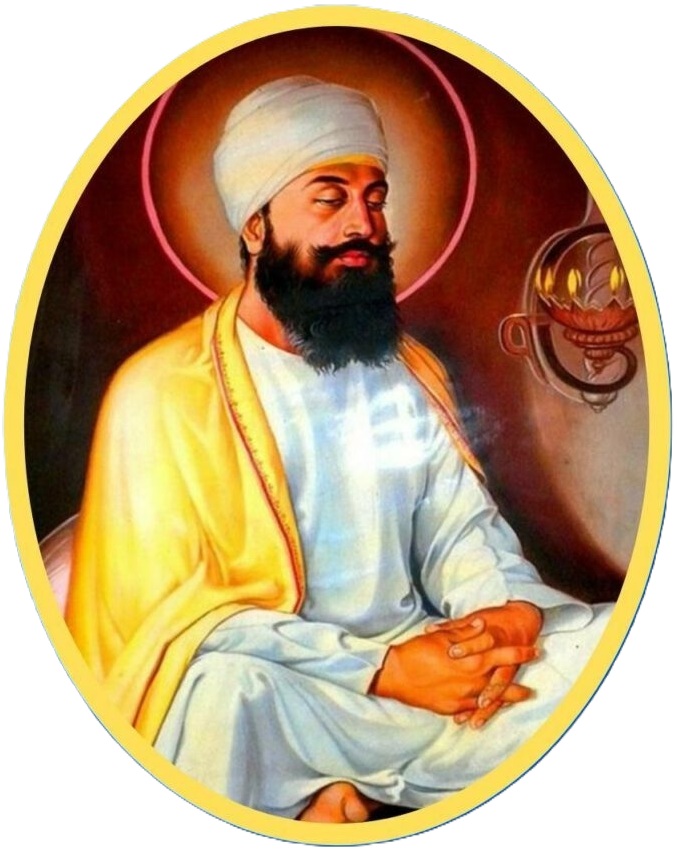
Guru Tegh Bahadur Sahib Ji
Hind di Chadar: the Shield of India who gave his head for the freedom of conscience
- Parkash
- 1 April 1621 (Vaisakh Vadi 5, Samvat 1678); observed on 18 April in the Nanakshahi calendar
Guru Ke Mahal, Sri Amritsar Sahib - Gurgaddi
- 20 March 1665 (formal installation at Bakala by Baba Gurditta Ji of Baba Buddha Ji's lineage); Bhai Makhan Shah Labana had proclaimed 'Guru Ladho Re' on 11 August 1664, the day traditionally remembered as the discovery of the Guru
Baba Bakala, Amritsar district - Shaheedi
- Shaheedi on 11 November 1675 (Maghar Sudi 5, Samvat 1732); observed on 24 November in the Nanakshahi calendar
Chandni Chowk, Delhi, where Gurdwara Sis Ganj Sahib now stands - Guruship
- 1664–1675
Jeevni (Life Story)
Sri Guru Tegh Bahadur Ji was born at Guru Ke Mahal in Amritsar on 1 April 1621 (Vaisakh Vadi 5, Samvat 1678), the fifth and youngest son of Sri Guru Hargobind Sahib Ji and the only child of Mata Nanaki Ji. He was named Tyag Mal, the master of renunciation, a name that his later years would fully justify. He grew up in the Guru's household at Amritsar during the stirring years when his father was raising the first Sikh army and holding court at Sri Akal Takht Sahib. Baba Buddha Ji taught him riding, swordsmanship and archery, and Bhai Gurdas Ji instructed him in Gurbani and the sacred literature of India. He was by nature quiet and reflective, given to long periods of meditation, but his courage was never in doubt. On 4 February 1633 he was married at Kartarpur to Mata Gujri Ji, daughter of Bhai Lal Chand and Mata Bishan Kaur, who would become one of the most revered women in Sikh history.
In April 1635, at the age of fourteen, Tyag Mal took part in the Battle of Kartarpur against the forces of Painda Khan and Kale Khan. He fought with such skill and fearlessness that Guru Hargobind Sahib Ji renamed him Tegh Bahadur, the brave wielder of the sword. After the battle the Guru's family moved to Kiratpur Sahib, where Tegh Bahadur Ji remained until his father's Joti Jot in March 1644. Guru Hargobind Sahib Ji passed the Gurgaddi to his grandson Har Rai Ji, and asked Mata Nanaki Ji to take Tegh Bahadur Ji and Mata Gujri Ji to Bakala, her native village in the Majha. There Tegh Bahadur Ji lived for the better part of twenty years, spending long hours in meditation in an underground chamber, caring for his mother, giving in charity and making occasional journeys to pay his respects to Guru Har Rai Ji at Kiratpur. He sought nothing for himself; the Sikh chroniclers describe these years as a life of complete surrender to the Divine Will.
The call came in 1664. Sri Guru Har Krishan Sahib Ji, dying of smallpox in Delhi on 30 March, had answered the question of succession with two words: 'Baba Bakale'. Twenty-two pretenders, among them Dhir Mal of Kartarpur, promptly set themselves up at Bakala as the Guru, each with his own establishment and masands. The true Guru sat in his chamber and made no claim. The impasse was broken by Bhai Makhan Shah Labana, a wealthy trader from Tanda in Jhelum district, who had vowed five hundred gold mohurs to the Guru when his ship was saved in a storm. Arriving at Bakala and finding a crowd of claimants, he placed two mohurs before each; every one of them blessed him and took the coins. At last he was directed to the quiet house of Tegh Bahadur Ji, and when he placed two coins there Guru Sahib smiled and asked why he brought only two when he had promised five hundred, and showed him the shoulder wound he had taken in holding up the ship. Makhan Shah ran to the roof and cried 'Guru Ladho Re!' - the Guru is found - and the sangat rushed to the true Master. The traditional date of this discovery is 11 August 1664; the formal installation at Bakala, with Baba Gurditta Ji of Baba Buddha Ji's lineage applying the tilak, took place on 20 March 1665.
Dhir Mal did not accept defeat. His masand Shihan fired a shot that grazed Guru Sahib and plundered his house. The Sikhs under Makhan Shah retaliated, seized Dhir Mal's goods and brought him bound before the Guru along with the Adi Granth that he held. Guru Sahib set him free and returned everything, including the sacred Granth, saying that he had no quarrel with any man. In November 1664 Guru Sahib went to Amritsar to pay homage at Harmandir Sahib, but the masands in control of the shrine, fearing loss of their revenues, shut the doors against him. Guru Sahib sat for a while at the spot now marked by Gurdwara Thara Sahib and then withdrew to the village of Walla, whose women came out to serve him with love. Guru Sahib blessed them with the words 'Maian Rabb razaian' - may the women of this place be ever blessed by God - and the saying is remembered to this day. After touring the Majha and Malwa Guru Sahib returned to Kiratpur, but, finding the family of the earlier Gurus and the descendants of Baba Gurditta Ji settled there, he resolved to found a new centre.
On 19 June 1665 Guru Sahib purchased from Rani Champa of Kahlur (Bilaspur) the land of the ruined village of Makhowal on the Sutlej, a few miles from Kiratpur, and laid the foundation of a new town, which he named Chakk Nanaki after his mother. Under Guru Gobind Singh Ji it would become Anandpur Sahib, the City of Bliss. Guru Sahib did not stay long. In August 1665 he set out eastwards with Mata Nanaki Ji, Mata Gujri Ji and a body of Sikhs, preaching through the Malwa and the Bangar country, where Sikh traditions of the Sixth Master were still alive. At Dhamtan in November he was arrested by Alam Khan Rohilla on orders from Delhi, where complaints had been laid that the Guru was gathering followers and collecting money; he was taken to the capital and released in December through the good offices of Raja Ram Singh of Amber, son of the Mirza Raja Jai Singh who had hosted Guru Har Krishan Ji. The journey resumed through Mathura, Agra, Allahabad, Banaras, Sasaram and Gaya, with halts for Kirtan and preaching at each sangat, until the party reached Patna in 1666. Here Guru Sahib left the family in the care of his brother-in-law Kirpal Chand and the Patna sangat, and went on to Dhaka, where Bhai Bulaki Das and his aged mother had long awaited him.
It was while Guru Sahib was in Bengal that Mata Gujri Ji gave birth at Patna, on 22 December 1666 (Poh Sudi 7), to the child Gobind Rai, the future Guru Gobind Singh Ji. In 1668 Raja Ram Singh was ordered by Aurangzeb to lead an expedition against the Ahom kingdom of Assam, and, holding the Guru in reverence and fearing the perils of the campaign, asked Guru Sahib to accompany him. Guru Sahib agreed and camped at Dhubri on the Brahmaputra, where Guru Nanak Sahib had once stayed. The Ahom king Chakradhwaj Singha and his people also came to honour him, and through Guru Sahib's mediation the two sides came to terms without the destruction that had been feared. At Dhubri Guru Sahib had the soldiers raise a mound of earth with their shields as a memorial of peace; Gurdwara Damdama Sahib stands there today. Guru Sahib returned to Patna in 1670, met his son for the first time, and then set out for the Punjab by way of Delhi, while the family followed more slowly and halted at Lakhnaur near Ambala, where the Sikhs of the Punjab first saw the young Gobind Rai. The household was reunited at Chakk Nanaki in 1672.
The years from 1672 to 1675 were devoted to the Malwa and the Bangar. These dry tracts south of the Sutlej had been struck by drought and neglect, and their people were poor and oppressed. Guru Sahib moved from village to village with his sangat, had wells and tanks dug, distributed cattle and seed, built dharamsalas and planted trees. Hundreds of villages - among them Talwandi Sabo, Bathinda, Jind, Kaithal, Dhamtan and Kurukshetra - remember his visit with a Gurdwara. Thousands of Jat peasants entered the Sikh fold in these years, and the Malwa became, after the Majha, the second heartland of the Panth. Guru Sahib's reputation for fearless preaching and the growth of his following did not escape the attention of Aurangzeb, who in these same years was enforcing a stern policy against the religious practices of non-Muslims across the empire.
In Kashmir the governor Iftikhar Khan was pressing the Brahmins of the valley to convert to Islam, and in their despair a delegation of about sixteen Pandits led by Pandit Kirpa Ram Dutt of Mattan came to Anandpur, arriving on 25 May 1675, and laid their plight before the Guru. Guru Sahib sat in deep thought and remarked that the hour called for the sacrifice of a great soul. His son Gobind Rai, then nine years old, asked who could be greater than his father for such a purpose. Guru Sahib accepted the word of the child as the word of God. He told the Pandits to inform the authorities that they would embrace Islam if Guru Tegh Bahadur could be persuaded to do so. On 8 July 1675 Guru Sahib bestowed the Gurgaddi on Gobind Rai, and on 11 July left Anandpur with Bhai Mati Das, Bhai Sati Das, Bhai Dyala and Bhai Gurditta Ji, intending to go to Delhi. On 12 July they were arrested at Malikpur Ranghran near Ropar and held at Bassi Pathana near Sirhind for about four months, before being brought in chains to Delhi early in November 1675.
In Delhi Guru Sahib was offered the choice between embracing Islam, performing a miracle to prove his spiritual claims, or death. He declined to convert, saying that the Lord is one and that every person has the right to worship according to conscience, and refused to perform miracles, saying that these were the business of God and not of His servants. To break his resolve his companions were martyred before his eyes: Bhai Mati Das was bound between two posts and sawn in two from head to waist, reciting Japji Sahib; Bhai Dyala was seated in a cauldron of boiling water; Bhai Sati Das was wrapped in cotton and burnt alive. Guru Sahib remained unshaken. On 11 November 1675 (Maghar Sudi 5, Samvat 1732), under a banyan tree in Chandni Chowk opposite the Kotwali, Guru Sahib bathed, sat down and recited Japji Sahib, and the executioner Jalal-ud-din of Samana struck off his head with a single blow. The Nanakshahi calendar observes the Shaheedi on 24 November. A sudden dust storm darkened the city. Under its cover Bhai Jaita, a Sikh of the Ranghreta community, lifted the sacred head and carried it, riding day and night, to Anandpur Sahib, where the young Guru received it on 16 November and embraced him with the words 'Rangrete Guru ke bete' - the Ranghretas are the Guru's own sons. The head was cremated where Gurdwara Sis Ganj Sahib stands at Anandpur. Bhai Lakhi Shah Vanjara, a trader whose carts were passing, hid the body under bales of cotton, carried it to his home at Raisina and set fire to the house to cremate it; Gurdwara Rakab Ganj Sahib marks the spot, and Gurdwara Sis Ganj Sahib at Chandni Chowk marks the place of the Shaheedi.
Guru Tegh Bahadur Ji gave his life not for his own community alone but for the right of others - Kashmiri Brahmins whose faith was not his own - to worship as they chose. For this he has been called Hind di Chadar, the Shield of India, and his Shaheedi is unique in the history of religion. His son recorded it in Bachittar Natak: 'He protected the frontal mark and sacred thread of the Hindus and performed a mighty deed in this age of darkness... He gave his head but not his resolve.' The bani he left - 59 shabads and 57 saloks of serene detachment and fearlessness - was placed in the Adi Granth by Guru Gobind Singh Ji at Damdama Sahib in 1705–06 and is recited daily by Sikhs; the saloks are read at the close of Sri Guru Granth Sahib Ji and at the funeral rites of every Sikh. From the Shaheedi of the Ninth Master flowed, twenty-four years later, the creation of the Khalsa by the Tenth.
Journeys
Guru Tegh Bahadur Ji travelled further than any Guru since Guru Nanak Sahib. After his installation in 1665 he toured the Majha and the Malwa, founded Anandpur Sahib, and in August of that year set out towards the east. The route lay through the Malwa and the Bangar tract - Saifabad (Bahadurgarh), Dhamtan, Kaithal, Barna - where his arrest and release at Delhi delayed him; then through Mathura, Agra, Etawah, Kanpur, Allahabad (where the family stayed some months), Mirzapur, Banaras, Sasaram and Gaya to Patna, which became the family's home for several years. Leaving Mata Gujri Ji there, Guru Sahib went on through Monghyr and Rajmahal to Dhaka, the capital of Bengal, where Bhai Bulaki Das and the sangat established by Bhai Nattha Ji received him and where a Sangat Tola still bears his memory. In 1668 Guru Sahib accompanied Raja Ram Singh of Amber to Assam, camping at Dhubri on the Brahmaputra; his mediation brought peace between the Mughal army and the Ahom king Chakradhwaj Singha, and Gurdwara Damdama Sahib at Dhubri, where Guru Sahib had the soldiers raise a mound of earth with their shields, remains the most easterly of the great Sikh shrines. Returning through Patna in 1670, Guru Sahib came back to the Punjab by way of Delhi, while the family followed to Lakhnaur near Ambala, where the child Gobind Rai was first seen by the Sikhs of the Punjab. From 1672 to 1675 Guru Sahib made repeated tours of the Malwa and Bangar, visiting hundreds of villages from Kurukshetra and Jind to Talwandi Sabo and Bathinda. His final journey, from Anandpur through Ropar and Sirhind to Delhi, was made as a prisoner, and ended at Chandni Chowk.
Teachings
The bani of Guru Tegh Bahadur Ji is a sustained meditation on the transience of the world and the fearlessness that comes from devotion to the One. Its themes are the frailty of the body, the folly of attachment to wealth, friends and power, the certainty that death spares none, and the peace available to one who recognises the Lord within and sings His Name. Yet it is not a counsel of withdrawal: Guru Sahib described the man of true wisdom as one who 'frightens none and fears none' (bhai kahu ko det nahi, nahi bhai manat aan) and who regards praise and blame, gold and iron, friend and foe with the same equanimity, and he lived this ideal to the end. Guru Sahib taught that the mind, not the forest, is the place of renunciation; that Naam is the only wealth that accompanies the soul; that dharam is upheld by the willingness to give one's head rather than one's faith; and that the right of every human being to worship according to his or her own conscience is sacred. In the Malwa his teaching took the form of wells dug and cattle given, and in Delhi it took the form of his own Shaheedi, which Guru Gobind Singh Ji summed up in Bachittar Natak: 'He gave his head but not his resolve' - sis diya par sirar na diya.
Timeline
-
1621
Parkash at Guru Ke Mahal, Amritsar, on 1 April (Vaisakh Vadi 5), the youngest son of Sri Guru Hargobind Sahib Ji and Mata Nanaki Ji; named Tyag Mal, the master of renunciation.
-
1621–1635
Educated by Baba Buddha Ji and Bhai Gurdas Ji in Gurbani, the classics, riding and the martial arts, at Amritsar.
-
1633
Marriage to Mata Gujri Ji, daughter of Bhai Lal Chand and Mata Bishan Kaur of Kartarpur, on 4 February (Magh Sudi 15).
-
1635
At fourteen fights with great valour in the Battle of Kartarpur on 26–28 April; Guru Hargobind Sahib Ji names him Tegh Bahadur, the brave wielder of the sword.
-
1635–1644
Lives at Kiratpur Sahib with the Guru's household after the move from the plains.
-
1644
After the Joti Jot of Guru Hargobind Sahib Ji on 3 March, moves with Mata Nanaki Ji and Mata Gujri Ji to Bakala, his mother's village, and spends some twenty years there in meditation and quiet service.
-
1664
Guru Har Krishan Sahib Ji utters 'Baba Bakale' before merging with the Divine Light in Delhi on 30 March; twenty-two claimants set themselves up at Bakala.
-
1664
Bhai Makhan Shah Labana, fulfilling a vow of 500 gold mohurs, finds the true Guru and proclaims 'Guru Ladho Re' from the rooftop on 11 August (Bhadon Sudi 9).
-
1664
Dhir Mal's agent Shihan fires at Guru Sahib and plunders his house; the Sikhs recover the goods, and Guru Sahib returns everything, including the Adi Granth, to Dhir Mal.
-
1664
In November Guru Sahib visits Amritsar and is refused entry to Harmandir Sahib by the masands; the women of Walla village serve him, and Guru Sahib blesses them, 'Maian Rabb razaian'.
-
1665
Formal installation as Guru at Bakala on 20 March by Baba Gurditta Ji, great-grandson of Baba Buddha Ji; Guru Sahib then tours the Majha and Malwa and settles at Kiratpur.
-
1665
On 19 June lays the foundation of Chakk Nanaki - later Anandpur Sahib - on land purchased from Rani Champa of Kahlur near the ruined village of Makhowal.
-
1665
Sets out eastwards in August through the Malwa and Bangar; arrested at Dhamtan in November by Alam Khan Rohilla and taken to Delhi, where Raja Ram Singh of Amber secures his release in December.
-
1666
Travels through Mathura, Agra, Allahabad (Prayag), Banaras, Sasaram and Gaya to Patna, where the family is settled; Guru Sahib proceeds to Dhaka.
-
1666
Parkash of Sahibzada Gobind Rai at Patna on 22 December (Poh Sudi 7) while Guru Sahib is in Bengal.
-
1668–1670
Accompanies Raja Ram Singh's expedition to Assam; camps at Dhubri on the Brahmaputra and brings about peace between the Mughals and the Ahom king; Gurdwara Damdama Sahib at Dhubri marks the site.
-
1670–1672
Returns via Patna, Delhi and Lakhnaur, where the family is reunited; the household reaches Chakk Nanaki (Anandpur Sahib) in 1672.
-
1672–1675
Extensive tours of the Malwa and Bangar: wells, dharamsalas and cattle are provided to drought-stricken villages, and thousands enter the Sikh fold.
-
1675
On 25 May a delegation of Kashmiri Pandits led by Pandit Kirpa Ram of Mattan arrives at Anandpur seeking protection from forced conversion; the nine-year-old Gobind Rai says none is worthier than Guru Sahib to make the sacrifice.
-
1675
Guru Sahib nominates Gobind Rai as his successor on 8 July and leaves Anandpur on 11 July with Bhai Mati Das, Bhai Sati Das, Bhai Dyala and Bhai Gurditta Ji; arrested at Malikpur Ranghran near Ropar on 12 July and held at Bassi Pathana near Sirhind for about four months.
-
1675
Brought in chains to Delhi in early November; Bhai Mati Das is sawn in two, Bhai Dyala boiled in a cauldron and Bhai Sati Das wrapped in cotton and burnt before Guru Sahib's eyes.
-
1675
Shaheedi at Chandni Chowk, Delhi, on 11 November (Maghar Sudi 5) under the banyan tree where Gurdwara Sis Ganj Sahib stands; Guru Sahib refuses to convert or perform miracles, and recites Japji Sahib before the executioner Jalal-ud-din of Samana strikes.
-
1675
Bhai Jaita (later Bhai Jeevan Singh) carries the sacred head to Anandpur, reaching it on 16 November; Bhai Lakhi Shah Vanjara carries the body in his cart to Raisina and sets fire to his own house to cremate it - the sites of Gurdwara Sis Ganj Anandpur Sahib and Gurdwara Rakab Ganj Sahib.
Legacy
Guru Tegh Bahadur Ji's Shaheedi stands as the supreme Sikh witness to freedom of conscience: a Guru gave his life so that people of another faith might practise theirs. The three Gurdwaras of Delhi - Sis Ganj Sahib at Chandni Chowk, Rakab Ganj Sahib at Raisina and the Sis Ganj at Anandpur Sahib - are among the holiest places in the Sikh world, and the martyrdom of Bhai Mati Das, Bhai Sati Das and Bhai Dyala is honoured alongside his own. Anandpur Sahib, which he founded, became the birthplace of the Khalsa and the seat of Takht Sri Kesgarh Sahib. His 115 compositions, the last bani to enter the Adi Granth, speak to every Sikh of the passing of worldly things and the fearlessness of the soul that knows the Lord, and his words 'bhai kahu ko det nahi, nahi bhai manat aan' define the Sikh ideal. His journeys planted sangats from Dhamtan to Dhubri, and the Gurdwaras along the Ganges, at Patna, Dhaka and in Assam, still mark his path. The 400th Parkash anniversary in 2021 was marked across India and the world, and his title Hind di Chadar remains a living description of what it means to protect the weak at the cost of one's own life.