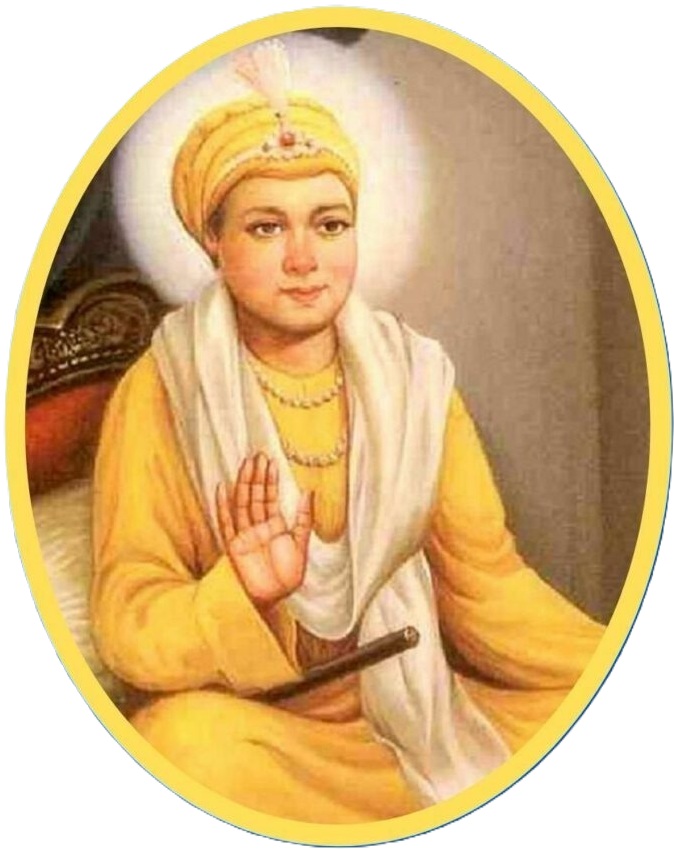
Guru Har Krishan Sahib Ji
Bala Pritam: the Child Guru whose sight dispels all sorrow
- Parkash
- 7 July 1656 (Sawan Vadi 10, Samvat 1713); observed on 23 July in the Nanakshahi calendar
Kiratpur Sahib, on the banks of the Sutlej - Gurgaddi
- 6 October 1661 (Katak Vadi 9, Samvat 1718); observed on 20 October in the Nanakshahi calendar
Kiratpur Sahib - Joti Jot
- 30 March 1664 (Chet Sudi 14, Samvat 1721); observed on 16 April in the Nanakshahi calendar
Delhi, on the banks of the Yamuna, where Gurdwara Bala Sahib now stands - Guruship
- 1661–1664
Jeevni (Life Story)
Sri Guru Har Krishan Sahib Ji was born at Kiratpur Sahib on 7 July 1656 (Sawan Vadi 10, Samvat 1713), the younger son of Sri Guru Har Rai Ji and Mata Krishan Kaur Ji, who is also known as Mata Sulakhni Ji. His elder brother, Baba Ram Rai Ji, was ten years his senior. The child grew up in the Guru's darbar in the town founded by his great-grandfather, Sri Guru Hargobind Sahib Ji, at the foot of the Shivalik hills on the Sutlej. From his earliest years he was known for his sweetness, his quietness and the ease with which he absorbed Gurbani; the sangat that gathered each day for Asa di Var and Kirtan noticed that the child sat through the long diwans with an attention beyond his age. His father, the gentlest of the Masters, saw in him the full light of Guru Nanak Sahib.
The circumstances that brought the Gurgaddi to a child of five arose from events at the imperial court. In 1660 Emperor Aurangzeb summoned Guru Har Rai Ji to Delhi to answer for his help to the fugitive prince Dara Shikoh and for passages in the Adi Granth that complainants had called offensive to Islam. Guru Har Rai Ji sent Ram Rai in his place, with strict instructions to answer truthfully and alter nothing. At court the boy, seeking to please the emperor, changed a word in a sabad of Guru Nanak Sahib, reading 'Mitti beiman ki' for 'Mitti Musalman ki'. Guru Har Rai Ji, hearing of this, declared that one who could tamper with the Word of the Guru to win imperial favour could never hold the Guru's seat, and forbade Ram Rai to return to his presence. Thus when Guru Har Rai Ji felt his end approaching in the autumn of 1661, he passed over his elder son and, gathering the sangat at Kiratpur, placed the coconut and five paise before Har Krishan Ji and bowed to him as the Eighth Master. It was 6 October 1661 (Katak Vadi 9, Samvat 1718). The same day Guru Har Rai Ji merged with the Divine Light.
For the next two and a half years the Child Guru held court at Kiratpur Sahib. Sikhs travelled from the Majha, the Malwa, the Doaba and far beyond to see him, and the testimony of the sangat is unanimous that none who came in doubt departed in doubt. Guru Sahib sat on the gaddi of his father and great-grandfather, received the offerings of the sangat, heard Kirtan and Katha, and watched over the langar and the dispensary that Guru Har Rai Ji had established. The daily routine of the Guru's house continued without interruption. Those who had served the Seventh Master, among them Diwan Dargah Mal and Bhai Gurditta Ji, the great-grandson of Baba Buddha Ji, surrounded the child with devotion, but all were clear that it was the Guru who guided them and not they the Guru. The Sikhs began to call him Bala Pritam, the Beloved Child, and Ashtam Balbir, the Brave Child of the Eighth Seat.
In Delhi, meanwhile, Ram Rai had not accepted his exclusion. He petitioned Aurangzeb that as the elder son he had been wrongfully passed over in favour of a child, and that the Guruship, along with the properties and offerings attached to it, should be his. The emperor, who had his own reasons for wishing to see the Guru's house brought under imperial supervision, ordered that the young Guru be brought to Delhi. The task was entrusted to Mirza Raja Jai Singh of Amber, one of the most powerful Rajput nobles of the empire, who was known to hold the Sikh Gurus in respect. Raja Jai Singh sent his emissaries to Kiratpur with assurances that no harm would be intended and that Guru Sahib would be his honoured guest. The Sikhs were uneasy, remembering the fate of Guru Arjan Dev Ji at Lahore and the imprisonment of Guru Hargobind Sahib Ji at Gwalior, but Guru Sahib agreed to go, telling them that he would not be made to appear before the emperor and that the Sikhs of Delhi had long awaited the Guru's visit.
The journey to Delhi began early in 1664. Guru Sahib travelled with Mata Krishan Kaur Ji and a party of Sikhs through Ropar and Banur to Ambala, and halted at the village of Panjokhra, a few miles further on. Here occurred the incident that has made Panjokhra a place of pilgrimage. A learned Brahmin of the village, Pandit Lal Chand, proud of his Sanskrit scholarship, came to the Guru's camp and asked how a child could bear the name Har Krishan, so close to the name of the Lord Krishna, and whether he could expound the Bhagavad Gita as the great commentators had done. Guru Sahib replied that the Guru's grace could make anyone a vessel of wisdom, and sent for the first man who passed - Chhajju Ram, an illiterate water-carrier of low caste. Guru Sahib touched his head with his cane, and the water-carrier gave an exposition of the Gita so profound that Lal Chand fell at the Guru's feet. Both Lal Chand and Chhajju became Sikhs; tradition records that Lal Chand later took Amrit from Guru Gobind Singh Ji and attained Shaheedi at Chamkaur. Gurdwara Panjokhra Sahib marks the site, and the lesson - that divine knowledge is a gift of grace, not of caste or learning - became a cornerstone of Sikh teaching.
In Delhi Guru Sahib was lodged at the bungalow of Raja Jai Singh in the Raisina area, on the site where Gurdwara Bangla Sahib stands today. The Rani of Amber, having heard of the Guru's spiritual sight, wished to test it: she dressed as a maidservant and seated herself among her attendants, who were arrayed in royal finery. The child Guru walked past them all, went straight to the Rani and sat in her lap, saying that she had wished to see whether the Guru knew his own. The Raja and Rani became devoted Sikhs. The sangat of Delhi came in great numbers to the bungalow, and Guru Sahib held diwan daily. Aurangzeb's attempt to have Guru Sahib appear at the court was deflected; according to the Sikh sources Guru Sahib made clear that he had come to Delhi for the sangat and would not perform miracles or debate before the emperor, and Raja Jai Singh managed the matter so that no confrontation occurred.
It was during these weeks that a terrible epidemic of smallpox and cholera broke out in Delhi. Thousands fell ill and the poor died in the streets, abandoned by all. The Child Guru went out among them daily. He tended the sick with his own hands, comforted the dying, arranged food and medicine, and made no distinction between Hindu and Muslim, high caste and low. The water of the well in the compound of the bungalow was given to the afflicted and was received by them as a source of healing; the sarovar at Gurdwara Bangla Sahib, where the sangat still takes the holy water, descends from that well. The people of Delhi, who had come to see a child of seven, found in him a healer and a protector, and his name spread through the city.
Guru Sahib himself was stricken with smallpox. As the fever rose he had himself moved out of the city to a camp on the banks of the Yamuna, and the Sikhs gathered around him in grief. When Mata Krishan Kaur Ji and the Sikhs asked who would succeed him, Guru Sahib called for the coconut and five paise that had marked every succession since Guru Nanak Sahib, waved his hand three times in the direction of Bakala and uttered the two words 'Baba Bakale' - the Baba at Bakala. The Sikhs understood that the next Guru would be found at the village of Bakala in the Majha, where Guru Tegh Bahadur Ji, the youngest son of Guru Hargobind Sahib Ji, had lived in quiet meditation for twenty years. Having thus secured the continuity of the Guruship, Sri Guru Har Krishan Sahib Ji merged with the Divine Light on 30 March 1664 (Chet Sudi 14, Samvat 1721), aged seven years and eight months. The last rites were performed on the bank of the Yamuna at the place where Gurdwara Bala Sahib now stands.
Mata Krishan Kaur Ji and the Sikhs returned to Kiratpur, and the search for the Guru at Bakala began. Twenty-two claimants set themselves up as Guru in the village, but later that year Bhai Makhan Shah Labana, a Sikh trader whose ship had been saved in a storm after a vow to the Guru, found the true Master and cried from the rooftop 'Guru Ladho Re' - the Guru is found. Guru Tegh Bahadur Ji's Guruship fulfilled the dying words of the Child Guru. In the hundred and fifty years that followed, Sikhs continued to gather at Raja Jai Singh's bungalow and at the Yamuna bank, and in the nineteenth century Sardar Baghel Singh, who had entered Delhi at the head of a Sikh army in 1783, raised the first shrines at both sites. Today Gurdwara Bangla Sahib, with its golden dome and sarovar, and Gurdwara Bala Sahib, where the last rites of Mata Sundari Ji and Mata Sahib Kaur Ji were also later performed, are among the most visited Gurdwaras in the world, and every Sikh, in the daily Ardas, remembers the Child Guru whose very sight removes all sorrow.
Journeys
Guru Har Krishan Sahib Ji's short life allowed only one great journey, but it has been remembered for over three and a half centuries. Early in 1664, accompanied by Mata Krishan Kaur Ji, Diwan Dargah Mal, Bhai Gurditta Ji (a descendant of Baba Buddha Ji) and other Sikhs, Guru Sahib left Kiratpur Sahib for Delhi at the request of Mirza Raja Jai Singh, who had pledged for his safety before the emperor. The party travelled through Ropar and Banur, where a Gurdwara commemorates the halt, to Ambala, and then to the village of Panjokhra, scene of the famous meeting with Pandit Lal Chand and the water-carrier Chhajju. From there the road ran through Kurukshetra and Karnal to Delhi, where Guru Sahib was received at Raja Jai Singh's bungalow near Raisina, today the site of Gurdwara Bangla Sahib. Guru Sahib's final days were spent in a camp beside the Yamuna, at the place now marked by Gurdwara Bala Sahib. All along the route villagers crowded to see the Child Guru, and Gurdwaras at Banur, Ambala and Panjokhra Sahib still mark his passage.
Teachings
Guru Har Krishan Sahib Ji taught more by presence than by discourse, and his brief Guruship carries a message the Sikhs have never forgotten: that the Guru's light is not bound by age, scholarship or worldly standing. At Panjokhra he showed that true knowledge is a gift of divine grace, not of birth or learning, when an unlettered water-carrier expounded sacred scripture at his touch. In Delhi he showed that the Guru's place is among the suffering, not in the courts of the powerful, going daily among the victims of plague and giving his own health in their service. He declined to make a show of himself before Aurangzeb, upholding the principle that the Guru answers to God alone, and by pointing the Sikhs to Bakala he taught that the Guruship belongs to the Divine Light and not to any claimant's ambition. In the Ardas the Sikhs remember that his very sight removes all sorrow - a reminder that compassion, humility and fearless service are the marks of the Guru's house.
Timeline
-
1656
Parkash at Kiratpur Sahib on 7 July (Sawan Vadi 10), the younger son of Sri Guru Har Rai Ji and Mata Krishan Kaur Ji.
-
1656–1661
Childhood at Kiratpur Sahib in the Guru's darbar, where he hears Kirtan and Katha daily and shows an early absorption in Gurbani.
-
1660–1661
His elder brother Baba Ram Rai Ji, sent to Aurangzeb's court, alters a word of Gurbani and is excluded from the succession by Guru Har Rai Ji.
-
1661
Gurgaddi bestowed by Sri Guru Har Rai Ji at Kiratpur Sahib on 6 October (Katak Vadi 9), when Har Krishan Ji is five years old; Guru Har Rai Ji merges with the Divine Light the same day.
-
1661–1663
Guru Sahib holds court at Kiratpur Sahib; sangats from across the Punjab come to see the Child Guru, and the daily Kirtan, Katha and langar continue under his presence.
-
1662–1663
Ram Rai, in Delhi, petitions Aurangzeb that he, the elder son, has been wrongly passed over; the emperor orders the Guru to be brought to Delhi.
-
1664
Mirza Raja Jai Singh of Amber, sent by the emperor, persuades Guru Sahib to travel to Delhi with assurances of safety; Guru Sahib sets out early in the year with Mata Krishan Kaur Ji and a party of Sikhs.
-
1664
At Panjokhra near Ambala, the proud Pandit Lal Chand challenges the Child Guru; Guru Sahib touches the illiterate water-carrier Chhajju with his cane and he expounds the Bhagavad Gita. Gurdwara Panjokhra Sahib marks the spot.
-
1664
Guru Sahib arrives in Delhi and stays at the bungalow of Raja Jai Singh in Raisina, the site of Gurdwara Bangla Sahib; the Rani tests the Guru by sitting disguised among her maids, and the child walks straight to her.
-
1664
A severe epidemic of smallpox and cholera sweeps Delhi; Guru Sahib goes among the sufferers daily, tending the sick and the dying, and the water of the well at the bungalow is given to the afflicted.
-
1664
Guru Sahib is himself stricken with smallpox and moves to a camp on the banks of the Yamuna.
-
1664
Asked who will succeed him, Guru Sahib calls for the coconut and five paise, waves his hand three times and utters 'Baba Bakale', indicating Guru Tegh Bahadur Ji at Bakala.
-
1664
Guru Har Krishan Sahib Ji merges with the Divine Light on 30 March (Chet Sudi 14) at the age of seven years and eight months; the last rites are performed on the Yamuna bank, where Gurdwara Bala Sahib stands.
-
1664
Mata Krishan Kaur Ji and the Sikhs return to Kiratpur; the Sikhs seek the new Guru at Bakala, where Bhai Makhan Shah Labana proclaims Guru Tegh Bahadur Ji later that year.
Legacy
The Guruship of Sri Guru Har Krishan Sahib Ji lasted barely two and a half years and ended before his eighth birthday, yet its influence on Sikh life has been deep and lasting. His name is invoked in the Ardas offered in every Gurdwara and every Sikh home - 'Sri Har Krishan dhiaiai jis dithe sab dukh jaye' - words composed by Guru Gobind Singh Ji in Chandi di Var and recited by Sikhs for over three centuries. His service during the Delhi epidemic made him a model of selfless seva and gave the Sikhs Gurdwara Bangla Sahib, whose sarovar and langar serve tens of thousands every day; Sikh hospitals and medical missions in Delhi and beyond are named after him. Panjokhra Sahib stands as a permanent witness that spiritual wisdom is a gift of grace rather than of caste or learning. And his words 'Baba Bakale' preserved the unbroken chain of the Guruship, leading the Sikhs to Guru Tegh Bahadur Ji and, through him, to Guru Gobind Singh Ji and the Khalsa. In the Child Guru the Sikhs see the truth that the light of Guru Nanak Sahib shone equally in a child of five as in the warrior-saints who came before and after him.