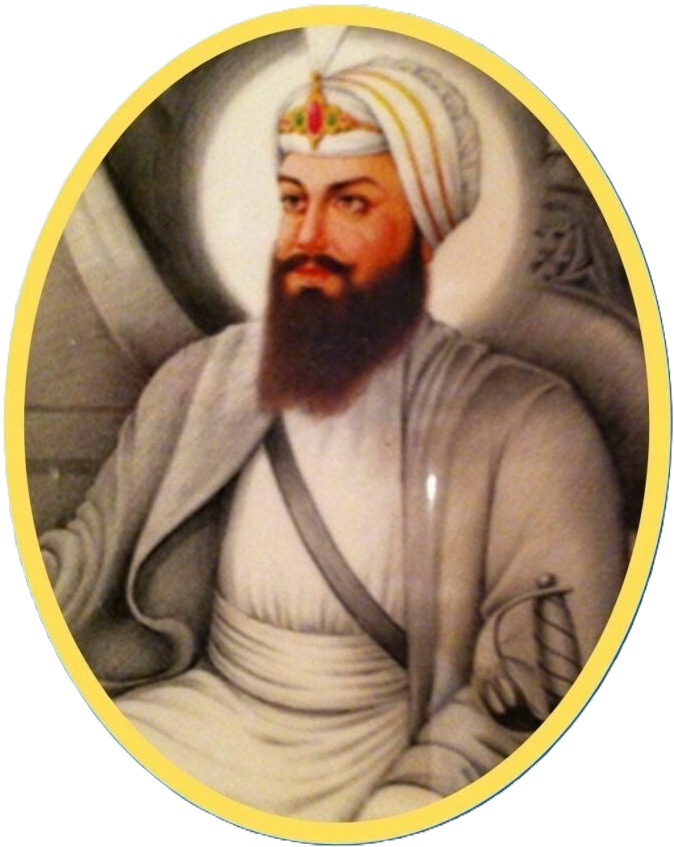
Guru Har Rai Sahib Ji
The gentle Master whose compassion embraced every creature and every seeker
- Parkash
- 16 January 1630 (Magh Sudi 13, Samvat 1686); some sources give 26 February 1630, and the Nanakshahi calendar observes 31 January
Kiratpur Sahib, on the banks of the Sutlej - Gurgaddi
- 3 March 1644 (Chet Sudi 5, Samvat 1701); some sources give 8 March 1644
Kiratpur Sahib - Joti Jot
- 6 October 1661 (Katak Vadi 9, Samvat 1718); observed on 20 October in the Nanakshahi calendar
Kiratpur Sahib - Guruship
- 1644–1661
Jeevni (Life Story)
Sri Guru Har Rai Ji was born at Kiratpur Sahib on 16 January 1630 (Magh Sudi 13, Samvat 1686), the younger of the two sons of Baba Gurditta Ji and Mata Nihal Kaur Ji. His father was the eldest Sahibzada of Sri Guru Hargobind Sahib Ji and the head of the Udasi order; his elder brother was Dhir Mal. The child grew up in the shadow of the Shivalik hills in the town his grandfather had founded only four years before, surrounded by the sangats that came to the Sixth Master's court and by the heroic ballads sung by the dhadis. Yet it was his tenderness rather than his martial training that marked him from the first. Tradition relates that one day, hurrying through the garden in a loose flowing robe, the boy brushed against a rose bush and scattered its petals on the ground. Guru Hargobind Sahib Ji, who was watching, gently told him that one who wears a large robe should walk with care so as to harm nothing. Har Rai Ji took the words to heart, and for the rest of his life was known to lift the hem of his garment lest a flower or an insect be hurt.
His father Baba Gurditta Ji merged with the Divine Light in 1638, when Har Rai Ji was eight, and the boy was brought up thereafter under the direct care of Guru Hargobind Sahib Ji, who loved him dearly and trained him in Gurbani, horsemanship and the use of arms. In 1640 he was married to Mata Krishan Kaur Ji, also known as Sulakhni Ji, the daughter of Daya Ram of Anupshahr on the Ganga. Two sons were born of the marriage: Baba Ram Rai Ji in 1646 and Sahibzada Har Krishan Ji in 1656. As Guru Hargobind Sahib Ji's own earthly days drew to a close, he passed over his surviving sons and his elder grandson Dhir Mal, who had remained at Kartarpur in possession of the Adi Granth and had shown little regard for the Guru's house, and chose instead the fourteen-year-old Har Rai Ji. On 3 March 1644 (Chet Sudi 5, Samvat 1701) the Sixth Master placed the coconut and five paise before his grandson, bowed to him as Guru, and the same day merged with the Divine Light at Kiratpur Sahib.
Guru Har Rai Ji was asked by the departing Master to keep the force of 2,200 horsemen in readiness, and he honoured that instruction throughout his Guruship, holding the troops in discipline and taking them hunting in the hills; but in seventeen years he never once led them into battle. The martial tradition of Miri-Piri was preserved in full, yet the age called for a different expression of the same strength. At Kiratpur Guru Sahib laid out a large herb garden and established a dispensary and hospital where rare medicines were prepared and given freely to all who came, regardless of creed. He also created a sanctuary for animals and birds, including deer and other creatures rescued from hunters, which became known throughout the region. The daily life of the town revolved around the Guru's darbar: Asa di Var was sung before dawn, Katha and Kirtan continued through the day, and the Guru ka Langar fed every visitor. Guru Sahib would often say that the body is the temple of the Lord and that service to the sick is service to Him.
The fame of the Kiratpur dispensary reached the imperial court when Prince Dara Shikoh, the eldest and favourite son of Shah Jahan, fell gravely ill - according to tradition from poison administered by a rival, or from a dangerous illness that resisted every remedy. The royal physicians prescribed a treatment requiring rare ingredients, among them a special variety of harad (chebulic myrobalan), cloves of unusual size and other herbs, which could be found nowhere but in the Guru's garden at Kiratpur. Shah Jahan sent a request to Guru Sahib, who gave the medicines at once and without condition, remarking that one hand of the Lord's creation does not refuse to help the other, just as the sandalwood tree does not withhold its fragrance from the axe that cuts it. The prince recovered, and Dara Shikoh, himself a seeker drawn to Sufism and to the saints of every faith, became devoted to Guru Sahib. For the remainder of Shah Jahan's reign the house of the Guru and the imperial court were at peace.
Guru Sahib used these years of peace to travel and to consolidate the Panth. He toured the Malwa several times, resting at Nathana and Mehraj, and there blessed two orphaned boys, Sandali and Phul, nephews of Chaudhari Kala of the Siddhu-Brar clan. Seeing the younger boy, Phul, patting his belly in hunger, Guru Sahib blessed him that he and his descendants would never want for food and that their horses would drink from the Yamuna; from Phul descend the Phulkian ruling houses of Patiala, Nabha and Jind. In the Doaba and Majha Guru Sahib visited Kartarpur, Goindwal, Lahore and Amritsar, strengthened the sangats, and set about reorganising the missionary system. Trusted Sikhs were appointed to head Bakhshishes, or endowed preaching centres: Bhai Pheru Ji on the Rajasthan border, Bhai Gonda Ji at Kabul, Bhai Nattha Ji at Dhaka, Bhai Bhagat Bhagwan Ji (originally Bhagat Gir, a learned ascetic converted by Guru Sahib) in Bihar and the east, and Bhai Jodh Ji among others. Through them the Guru's word reached far beyond the Punjab.
Many stories of this period show Guru Sahib's regard for Gurbani and for the humble Sikh. At Kiratpur Guru Sahib once rose suddenly from his seat and stood with folded hands; asked why, he explained that a Sikh far away was reciting Gurbani and had, in his distraction, left out a line, and the Guru had stood in deference to the Word. When Bhai Gonda Ji, absorbed in meditation at Kabul, forgot the time, Guru Sahib is said to have remained seated for hours in Kiratpur so as not to disturb the devotee's concentration on the Guru's feet. On another occasion a Sikh asked whether Gurbani recited without understanding had any merit, and Guru Sahib replied with the example of the broken pot that still carries the fragrance of the butter once kept in it. Guru Sahib also instructed the sangat to eat only after Kirtan and Katha, and to keep every Sikh home a place of hospitality, saying that the langar should never close.
The death of Shah Jahan's power in 1658 changed everything. In the war of succession that followed the emperor's illness, Dara Shikoh was defeated by his brother Aurangzeb at Samugarh near Agra on 29 May 1658 and fled north through the Punjab with Aurangzeb's forces in pursuit. Guru Sahib met the fugitive prince in the Punjab - tradition places the meeting at Goindwal on the Beas - and his horsemen held the river crossing long enough to delay the pursuers, allowing Dara to escape towards Lahore and Multan. It was an act of compassion towards a man in distress, not of alliance; Dara was later captured in Sindh and executed in Delhi in 1659. But Aurangzeb, now emperor, did not forget. Complaints also reached him that the Adi Granth contained passages derogatory to Islam, in particular the line of Guru Nanak Sahib in Asa di Var describing the clay of a Muslim grave being fired by a potter. In 1660 Guru Sahib was summoned to Delhi to explain himself.
Guru Sahib did not go. Instead he sent his elder son, Baba Ram Rai Ji, then about fourteen years old, with a party of trusted Sikhs, instructing him to answer every question truthfully and to alter nothing of the Guru's Word, promising that the Guru's grace would protect him. At the court Ram Rai impressed Aurangzeb with his learning and, tradition records, with displays of miraculous power. But when the emperor asked about the offending line, 'Mitti Musalman ki', the boy, anxious to please, replied that the true reading was 'Mitti beiman ki' - the clay of the faithless - and that the copyists had erred. Aurangzeb was satisfied and kept Ram Rai at court with honour. When the news reached Kiratpur, Guru Sahib was deeply grieved. He declared that Ram Rai had changed the Word of Guru Nanak Sahib to save his own position, that no Sikh may alter even one letter of Gurbani, and that his son should never again appear before him. Ram Rai remained in Delhi and later settled, with a Mughal grant, at the place that became Dehra Dun.
The strain of these events told upon Guru Sahib, who was only thirty-one. In the autumn of 1661, knowing that his time had come, he gathered the sangat at Kiratpur and bestowed the Gurgaddi on his younger son, Har Krishan Ji, who was then five years old, placing before him the coconut and five paise and bowing to him as the Eighth Master. Guru Sahib told the Sikhs that the child possessed the light of Guru Nanak Sahib in full measure and that none should doubt him on account of his years. On 6 October 1661 (Katak Vadi 9, Samvat 1718) Sri Guru Har Rai Ji merged with the Divine Light at Kiratpur Sahib, where Gurdwara Patalpuri Sahib now stands beside the Sutlej. His Guruship of seventeen years had seen no battle and founded no city, yet it had kept the Panth whole through the transition from Shah Jahan to Aurangzeb, preserved the Guru's independence from the court and the purity of Gurbani, and left the Sikhs an abiding example of how great strength may be clothed in gentleness.
Journeys
Although Kiratpur Sahib remained his home, Guru Har Rai Ji travelled repeatedly through the Punjab to meet the sangats. Several tours of the Malwa are recorded, during which Guru Sahib visited Nathana, Mehraj, Bathinda, Bhagta and the villages of the Brar and Siddhu clans, blessing Chaudhari Kala's orphaned nephews Sandali and Phul - the latter the ancestor of the Phulkian states of Patiala, Nabha and Jind. Guru Sahib also toured the Doaba and Majha, visiting Kartarpur, Goindwal, Lahore and the Amritsar region, and tradition records his passage through Sialkot, Pathankot and the hill tracts of Kangra and Jammu, as well as a visit to Kurukshetra, where he preached to pilgrims gathered for the solar eclipse. He sent trusted Sikhs far beyond the Punjab: Bhai Pheru Ji to the Rajasthan borderlands, Bhai Gonda Ji to Kabul, Bhai Nattha Ji to Dhaka and Bhai Bhagat Bhagwan Ji to the east, each heading a Bakhshish or preaching centre. In 1658 Guru Sahib's hospitality to the fugitive prince Dara Shikoh at the Beas was an act of mercy that would bring Aurangzeb's summons to Delhi - a journey Guru Sahib chose not to make in person, sending his son in his place.
Teachings
Guru Har Rai Ji's teaching was the teaching of Guru Nanak Sahib lived through tenderness. He taught that the Sikh must harm no living being needlessly, that the sick and the poor are to be served without distinction of faith or caste, and that the daily rhythm of Naam Simran, Kirtan and langar is the ground on which every other virtue grows. Guru Sahib placed the highest value on the sanctity of Gurbani: when a Sikh once asked whether the Guru's word could ever lose its power upon one who did not understand it, Guru Sahib compared it to a broken pot smeared with butter - even the fragments retain their fragrance. Likewise, when Ram Rai altered a single word of Guru Nanak Sahib's sabad to please the emperor, Guru Sahib's response made clear that no worldly advantage could justify tampering with the Word. Guru Sahib preserved the martial discipline of Miri-Piri, keeping his horsemen ready, yet never drew the sword, showing that strength exists to protect, not to provoke. Above all he taught that a Sikh should be a healer - of bodies, through the dispensary; of minds, through Gurbani; and of society, through fearlessness before power.
Timeline
-
1630
Parkash at Kiratpur Sahib on 16 January (Magh Sudi 13), the younger son of Baba Gurditta Ji and Mata Nihal Kaur Ji, grandson of Sri Guru Hargobind Sahib Ji.
-
c. 1636
As a child, his loose robe knocks petals from a rose bush in the garden; Guru Hargobind Sahib Ji gently teaches him to walk with care so as to harm nothing, a lesson that shapes his life of compassion.
-
1638
Baba Gurditta Ji, his father, merges with the Divine Light at Kiratpur; the young Har Rai Ji is raised under the direct care of Guru Hargobind Sahib Ji.
-
1640
Marriage to Mata Krishan Kaur Ji (Sulakhni Ji), daughter of Daya Ram of Anupshahr in the Bulandshahr district.
-
1644
Gurgaddi bestowed by Sri Guru Hargobind Sahib Ji at Kiratpur Sahib on 3 March at the age of fourteen; Guru Hargobind Sahib Ji merges with the Divine Light the same day.
-
1644–1645
Guru Sahib maintains the force of 2,200 horsemen inherited from the Sixth Master, as instructed, and establishes a dispensary, herb garden and animal sanctuary at Kiratpur.
-
1646
Birth of Baba Ram Rai Ji at Kiratpur Sahib.
-
c. 1646–1650
Prince Dara Shikoh, eldest son of Shah Jahan, falls gravely ill; the rare medicines (including harad, lavang and other herbs) requested by the emperor are supplied from the Kiratpur dispensary, and the prince recovers.
-
c. 1650–1657
Guru Sahib tours the Malwa, Doaba and Majha; at Nathana he blesses the brothers Sandali and Phul, from whom descend the ruling houses of Patiala, Nabha and Jind; many Sikh centres are established.
-
1656
Parkash of Sahibzada Har Krishan Ji at Kiratpur Sahib on 7 July (Sawan Vadi 10).
-
1658
After his defeat at Samugarh in May, Dara Shikoh flees north; Guru Sahib meets him in the Punjab and his horsemen hold the Beas crossing at Goindwal, delaying the pursuing forces of Aurangzeb.
-
1659–1660
Aurangzeb, now emperor, summons Guru Sahib to Delhi to explain his help to Dara Shikoh and alleged anti-Islamic passages in the Adi Granth.
-
1660–1661
Guru Sahib sends Baba Ram Rai Ji to the court with instructions to answer truthfully and change nothing; Ram Rai alters the word 'Musalman' to 'beiman' in a sabad of Guru Nanak Sahib to please Aurangzeb, and Guru Sahib forbids him to return to his presence.
-
1661
Guru Sahib bestows the Gurgaddi on his younger son Har Krishan Ji, aged five, at Kiratpur Sahib.
-
1661
Guru Har Rai Sahib Ji merges with the Divine Light at Kiratpur Sahib on 6 October (Katak Vadi 9) at the age of thirty-one; Gurdwara Patalpuri Sahib marks the place.
Legacy
Guru Har Rai Ji is cherished as the Guru of compassion and healing. His dispensary at Kiratpur is remembered as the first Sikh hospital, and free medical camps and dispensaries run by Sikh organisations today draw inspiration from it; his animal sanctuary made him an early guardian of the natural world in the Sikh tradition. His refusal to compromise on Gurbani, even at the cost of his own son's succession, fixed for all time the principle that the Guru's Word is inviolable - a principle that the Khalsa would later uphold with their lives. The Bakhshishes and Manjis he reorganised carried Sikhi from Kabul to Dhaka, and his blessing to Phul shaped the political map of the Malwa for three centuries. Gurdwara Sheesh Mahal and Gurdwara Patalpuri at Kiratpur Sahib, Gurdwara Nathana Sahib in the Malwa and shrines at Goindwal keep his memory, and the Sikh Ardas remembers him daily among the ten Masters whose light was one.