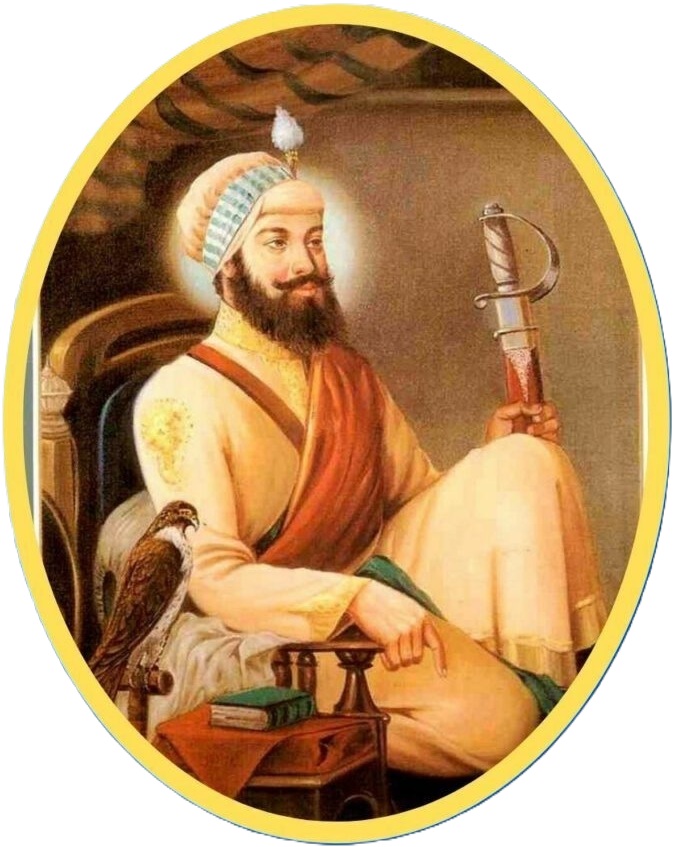
Guru Hargobind Sahib Ji
Miri-Piri da Malik: the Master who wore the two swords of spirit and sovereignty
- Parkash
- 19 June 1595 (Harh Vadi 1, Samvat 1652)
Guru Ki Wadali, near Amritsar - Gurgaddi
- 25 May 1606 (Jeth Vadi 14, Samvat 1663); observed on 11 June in the Nanakshahi calendar
Sri Amritsar Sahib - Joti Jot
- 3 March 1644 (Chet Sudi 5, Samvat 1701); some sources give 19 March 1644, the date observed in the Nanakshahi calendar
Kiratpur Sahib, on the banks of the Sutlej - Guruship
- 1606–1644
Jeevni (Life Story)
Sri Guru Hargobind Sahib Ji was born at Guru Ki Wadali, a village a few miles west of Amritsar, on 19 June 1595 (Harh Vadi 1, Samvat 1652), the only child of Sri Guru Arjan Dev Ji and Mata Ganga Ji. Tradition records that Mata Ganga Ji had gone on foot to Baba Buddha Ji, the venerable Sikh who had served since the days of Guru Nanak Sahib, carrying missi roti and onions she had prepared herself; crushing an onion with his fist the aged saint blessed her that she would have a son who would crush the heads of tyrants as easily. The child's early years were watched over by Guru Arjan Dev Ji with great love, and the sabad 'Poota mata ki asis' in Raag Gauri is cherished as a mother's blessing over him. Guru Arjan Dev Ji entrusted the boy's education to Bhai Gurdas Ji for Gurbani and letters, and to Baba Buddha Ji for riding, swimming, archery and the use of arms - a training that, in hindsight, prepared the Sixth Master for the age that was about to dawn.
The young Hargobind was married at Dalla in 1604 to Mata Damodari Ji, and later also to Mata Nanaki Ji of Bakala and Mata Mahadevi Ji (Marwahi). From these unions were born Baba Gurditta Ji, Bibi Viro Ji, Baba Suraj Mal Ji, Baba Ani Rai Ji, Baba Atal Rai Ji and, in 1621, Sahibzada Tyag Mal, who would one day become Sri Guru Tegh Bahadur Ji. In 1606 the household at Amritsar was plunged into grief. Emperor Jahangir, offended by the Guru's growing influence and by complaints of the Guru's enemies, had Guru Arjan Dev Ji arrested and tortured at Lahore. Before leaving for Lahore Guru Arjan Dev Ji had bestowed the Gurgaddi on his eleven-year-old son on 25 May 1606 (Jeth Vadi 14), with Baba Buddha Ji applying the tilak of succession. On 30 May 1606 Guru Arjan Dev Ji attained Shaheedi on the banks of the Ravi, sending word that his son should sit fully armed upon the throne and maintain an army to the best of his ability.
At the Gurgaddi ceremony the young Guru asked Baba Buddha Ji to gird him not with the seli (the woollen cord of renunciation worn by the earlier Gurus) but with two swords. One he named Piri, for spiritual authority, and the other Miri, for temporal power. This was the birth of the doctrine of Miri-Piri, which declared that the Sikh must be both a saint and a sovereign in his own right, answerable to God alone. In the same year Guru Sahib laid the foundation of Sri Akal Takht Sahib, the Throne of the Timeless One, facing Sri Harmandir Sahib across the parkarma at Amritsar. Only Baba Buddha Ji and Bhai Gurdas Ji were permitted to build the platform with their own hands, and from this seat, raised higher than the Mughal emperor's throne, Guru Sahib received the sangat, heard petitions, decided disputes and listened to dhadis sing heroic ballads. Harmandir Sahib remained the house of Naam and Kirtan; Akal Takht became the house of justice and courage. Guru Sahib also asked that offerings be made in horses and weapons, and soon a body of several hundred Sikh horsemen, divided into five companies, stood ready, and the fort of Lohgarh was raised to defend the city.
Such a transformation could not go unnoticed. Jahangir summoned Guru Sahib to Delhi, and whether out of suspicion, the intrigues of Chandu Shah and other enemies, or on the pretext of an unpaid fine, confined him in the fort of Gwalior, where many princes of defeated royal houses were held. The dates of the imprisonment are given variously in the sources, from about 1609 to 1612, and the length from a few months to several years. The Sikhs of Amritsar were bereft; Baba Buddha Ji led groups of devotees who travelled to Gwalior and circled the fort walls singing Gurbani and praying for Guru Sahib's release. Within the fort Guru Sahib's serene presence became a source of comfort to the imprisoned rajas. When at last Jahangir ordered Guru Sahib's release - tradition attributes this to the intercession of the Sufi saint Hazrat Mian Mir and to the emperor's own troubled conscience - Guru Sahib refused to leave unless the other prisoners were freed with him. The emperor relented, allowing to go free as many as could hold on to the Guru's garment; Guru Sahib had a robe made with fifty-two tassels, and all fifty-two princes walked out of Gwalior holding its hem. He was ever after called Bandi Chhor, the Liberator, and when he reached Amritsar the city was lit with lamps in welcome. That day of Diwali is remembered by Sikhs as Bandi Chhor Divas. Gurdwara Bandi Chhor Sahib stands within Gwalior Fort today.
For the remaining years of Jahangir's reign relations with the court were relatively cordial, and Guru Sahib used the period to travel and to strengthen the Panth. He toured the Punjab, settling the Malwa village of Mehraj for Bhai Mohan and his clan, and founded the town of Sri Hargobindpur on the Beas in 1621 on land that had been in dispute; when the local Mughal officials tried to seize it, the first armed clash of the Sikhs, at Ruhela (Rohilla), ended in their victory. At Sri Hargobindpur Guru Sahib also built a mosque for the Muslims of the town, a gesture of the same breadth of heart that had made him the friend of Mian Mir. Guru Sahib journeyed to Kashmir, to Nanakmata in present-day Uttarakhand, where he restored the shrine of Guru Nanak Sahib to its Udasi keepers, and through the Shivalik hills, where the Maratha saint Samarth Ramdas asked how a successor of Guru Nanak could ride a horse and carry arms. Guru Sahib's reply has echoed through the centuries: 'Within, a faqir; without, a prince. Arms are for the protection of the weak and the destruction of the tyrant.'
In 1626 Baba Gurditta Ji, the eldest Sahibzada, acquired land from Raja Tara Chand of Kahlur in the Shivalik foothills beside the Sutlej, and Guru Sahib founded the town of Kiratpur Sahib there. The place had been blessed by Baba Sri Chand Ji, the elder son of Guru Nanak Sahib, who had asked that Baba Gurditta Ji become the head of the Udasi order after him. Under Guru Sahib's direction the Udasi preachers Almast, Phul, Gonda and Balu Hasna were sent out to establish the four Dhuans or missionary hearths, carrying Sikhi to Nanakmata, the Gangetic plains and the east. Two of Guru Sahib's sons left this world in his lifetime: Baba Atal Rai Ji in 1628 at the age of nine, and Baba Gurditta Ji in 1638, both remembered with deep reverence.
The accession of Shah Jahan in 1628 brought renewed hostility. The first open battle came in April 1634, around the time of the wedding of Bibi Viro Ji at Amritsar, when Mughal troops under Mukhlis Khan attacked the city over a dispute about a royal hawk. The Sikhs held Lohgarh fort and fought near the site of Gurdwara Sangrana Sahib; Guru Sahib himself slew Mukhlis Khan in single combat, and the wedding was completed at Jhabal. Guru Sahib then moved to the Malwa. Later the same year Bhai Bidhi Chand Ji, in two celebrated feats of daring, recovered from Lahore Fort the horses Dilbagh and Gulbagh, which had been brought as offerings by Sikhs of Kabul and seized by Mughal officers. The imperial army under Lalla Beg and Qamar Beg followed Guru Sahib to Lahira near Mehraj, and in the Battle of Lahira in December 1634 the Mughal force was defeated with heavy loss, though Sikhs such as Bhai Jetha Ji also attained Shaheedi. The pool at the battlefield is now the sarovar of Gurdwara Gurusar.
The fourth battle was fought at Kartarpur in the Jalandhar Doab on 26–28 April 1635. Painda Khan, once a trusted Pathan commander whom Guru Sahib had raised from childhood, had turned against him and brought an imperial force under Kale Khan. In the battle the fourteen-year-old Tyag Mal fought with such courage that Guru Sahib renamed him Tegh Bahadur, the brave wielder of the sword; Baba Gurditta Ji and Bhai Bidhi Chand Ji also distinguished themselves. Painda Khan fell in single combat with Guru Sahib, who, as he lay dying, shaded his face from the sun with his shield and spoke to him with forgiveness. After a final skirmish at Palahi near Phagwara, Guru Sahib withdrew to Kiratpur Sahib in 1635 and never again took the field. Four battles had been fought and four won, yet Guru Sahib had never seized a yard of territory: the sword had been drawn only in defence.
The last nine years at Kiratpur were years of peace. Guru Sahib held daily diwans, received sangats from distant lands, and gave personal attention to the upbringing of his grandsons, the sons of Baba Gurditta Ji - Dhir Mal, who stayed at Kartarpur in possession of the Adi Granth, and the gentle Har Rai Ji, whom Guru Sahib loved deeply. When the child's loose robe once knocked the petals from a rose bush in the garden, Guru Sahib gently told him to walk with care so as not to harm even a flower, a lesson that shaped the Seventh Master's tender heart. Baba Buddha Ji had merged with the Divine Light at Ramdas in 1631 and Bhai Gurdas Ji at Goindwal in 1636 or 1637, and Guru Sahib himself had performed their last rites.
Early in 1644 Guru Sahib announced that his earthly mission was complete. He passed over his surviving sons and his grandson Dhir Mal, and on 3 March 1644 (Chet Sudi 5, Samvat 1701) bestowed the Gurgaddi on the fourteen-year-old Har Rai Ji, placing before him the coconut and five paise and bowing to him as Guru. Guru Hargobind Sahib Ji then merged with the Divine Light at Kiratpur Sahib on the banks of the Sutlej, where Gurdwara Patalpuri Sahib now stands. In thirty-eight years as Guru he had turned a community of peaceful devotees into a people who could pray and fight with equal devotion, and had given the Sikhs the Akal Takht, the sword of Miri-Piri and the memory of Bandi Chhor - the foundations on which Guru Gobind Singh Ji would later raise the Khalsa.
Journeys
Guru Hargobind Sahib Ji travelled more widely than any Guru since Guru Nanak Sahib. From Amritsar he toured the Majha, Doaba and Malwa regions of the Punjab, establishing sangats and settling disputes, and founded new towns at Sri Hargobindpur on the Beas and Mehraj in the Malwa. After the Gwalior episode Guru Sahib journeyed through Delhi and the Gangetic plains, and tradition records visits to Nanakmata (formerly Gorakhmata) near Pilibhit, where he restored the shrine of Guru Nanak Sahib to the Udasi sadhus, and to Kashmir, where Mai Bhag Bhari of Srinagar presented the robe she had lovingly stitched for him. In the Shivalik hills Guru Sahib met the Maratha saint Samarth Ramdas at Srinagar in Garhwal and gave the famous reply 'batan fakiri, zahir amiri' - a saint within, a prince without. The later years were spent at Kiratpur Sahib on the Sutlej, from where Guru Sahib directed the missionary work of Bhai Gurdas Ji (sent to Kabul and Kashi), Bhai Bidhi Chand Ji (to Bengal), Baba Almast Ji (to Nanakmata and the east) and Bhai Phul Ji (to the Gangetic region), the preachers known as the Dhuans (hearths) of the Udasi mission.
Teachings
Guru Hargobind Sahib Ji taught that the life of the spirit and the responsibility to resist tyranny are not two paths but one. The two swords of Miri and Piri declared that a Sikh who meditates on Naam must also be ready to protect the weak, and that worldly power is to be exercised only in the service of righteousness and under the discipline of the Divine Name. Guru Sahib changed nothing in the message of Guru Nanak Sahib - Naam Japna, Kirat Karni and Vand Chhakna remained the heart of Sikh life - but added to it the duties of physical fitness, courage and readiness to defend dharam. Guru Sahib honoured the Adi Granth as the living Word, kept the daily Kirtan and Katha at Harmandir Sahib, and showed through his own example that a Guru could be a householder, a soldier and a saint without contradiction. His compassion was universal: the princes he freed at Gwalior were Hindu rajas, his friends included Sufi faqirs such as Mian Mir and Sain Ras, and he insisted that the sword was never to be raised in anger or for conquest.
Timeline
-
1595
Parkash at Guru Ki Wadali near Amritsar on 19 June (Harh Vadi 1), the only child of Sri Guru Arjan Dev Ji and Mata Ganga Ji, born by the blessing of Baba Buddha Ji.
-
1600–1605
Trained by Baba Buddha Ji in riding, archery and the use of arms, and by Bhai Gurdas Ji in Gurbani and the sacred texts.
-
1604
Marriage to Mata Damodari Ji, daughter of Bhai Narain Das of Dalla, in Dalla village near Sultanpur Lodhi.
-
1606
Gurgaddi bestowed by Sri Guru Arjan Dev Ji at Amritsar on 25 May (Jeth Vadi 14), days before Guru Arjan Dev Ji's Shaheedi at Lahore on 30 May.
-
1606
Guru Sahib wears two swords of Miri and Piri at the Gurgaddi ceremony and lays the foundation of Sri Akal Takht Sahib at Amritsar, with Baba Buddha Ji and Bhai Gurdas Ji completing the structure by hand.
-
1609
Lohgarh fort is built at Amritsar; Sikhs are asked to present horses and weapons as offerings and a standing force of Sikh horsemen is raised.
-
c. 1609–1612
Summoned to Delhi by Emperor Jahangir and confined in Gwalior Fort; the period of detention is variously given as a few months to several years. Baba Buddha Ji leads Sikhs who circumambulate the fort in prayer.
-
c. 1612
Released from Gwalior; Guru Sahib refuses to leave unless the fifty-two imprisoned princes are freed, and brings them out holding the hem of his robe (the Bandi Chhor). Amritsar celebrates with lamps on Diwali, the origin of Bandi Chhor Divas.
-
1613–1620
Guru Sahib tours the Majha, Doaba and Malwa regions, visits Kashmir (Srinagar, where Mai Bhag Bhari is blessed), Nanakmata and the Shivalik hills, and accompanies Jahangir to Kashmir on one occasion.
-
1621
Parkash of Sahibzada Tyag Mal, later Sri Guru Tegh Bahadur Ji, at Amritsar on 1 April (Vaisakh Vadi 5), to Mata Nanaki Ji.
-
1621
Sri Hargobindpur is founded on the Beas; the first armed clash at Ruhela (Rohilla) against the Mughal faujdar's forces over the land ends in Sikh victory.
-
1626
Kiratpur Sahib is founded on the Sutlej on land purchased from Raja Tara Chand of Kahlur (Bilaspur) by Baba Gurditta Ji.
-
1628
Baba Atal Rai Ji merges with the Divine Light at Amritsar at the age of nine; the nine-storey Gurdwara Baba Atal Rai stands in his memory.
-
1634
Battle of Amritsar (Sangrana Sahib and Lohgarh) in April, around the wedding of Bibi Viro Ji: Mukhlis Khan, the Mughal commander, is slain by Guru Sahib in single combat.
-
1634
Battle of Lahira (Mehraj, Malwa) in December, after Bhai Bidhi Chand Ji recovers the horses Dilbagh and Gulbagh from Lahore Fort; the Sikhs defeat Lalla Beg and Qamar Beg at Gurusar.
-
1635
Battle of Kartarpur (Jalandhar) on 26–28 April against Painda Khan and Kale Khan; the young Tyag Mal shows such valour that he is named Tegh Bahadur, 'brave of the sword'. A final skirmish follows at Palahi near Phagwara.
-
1635
Guru Sahib withdraws from the plains and settles permanently at Kiratpur Sahib, where he spends the last nine years teaching and preaching.
-
1638
Baba Gurditta Ji, the eldest Sahibzada and head of the Udasi order, merges with the Divine Light at Kiratpur.
-
1644
Guru Sahib bestows the Gurgaddi on his grandson Har Rai Ji and merges with the Divine Light at Kiratpur Sahib on 3 March (Chet Sudi 5). Gurdwara Patalpuri Sahib marks the site.
Legacy
Guru Hargobind Sahib Ji is remembered as the Guru who gave Sikhi its martial dimension without diminishing its spiritual core. Sri Akal Takht Sahib, which he built, remains the supreme seat of Sikh temporal authority, from which Hukamnamas binding on the whole Panth are issued. The twin swords of Miri-Piri became the emblem on the Nishan Sahib and the Khanda, and the doctrine itself shaped the Khalsa ideal of the Sant-Sipahi, the saint-soldier. Bandi Chhor Divas is celebrated every year with lamps at Harmandir Sahib and in Sikh homes around the world. Kiratpur Sahib, which Guru Sahib founded, remains sacred as the place where the ashes of the departed are immersed in the Sutlej, and Gurdwaras at Guru Ki Wadali, Sangrana Sahib, Gurusar Mehraj, Kartarpur and Gwalior keep alive the memory of his life and battles. In the words of Bhai Gurdas Ji, who saw the transformation with his own eyes, the Guru's sword was 'a hedge of thorns around the orchard' of Guru Nanak's faith.