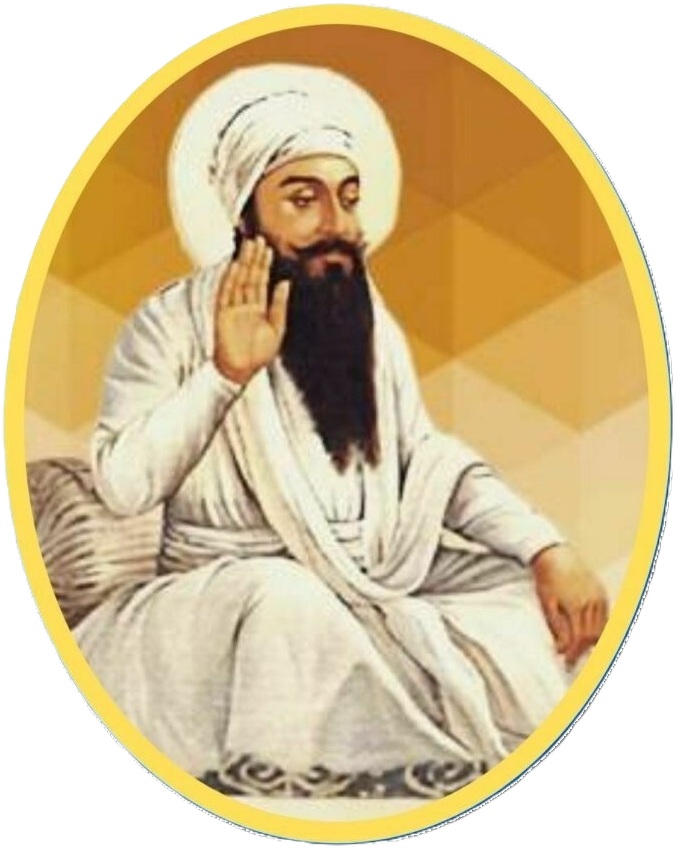
Guru Arjan Dev Ji
Compiler of the Adi Granth, builder of Harmandir Sahib, and the first Sikh martyr.
- Parkash
- 15 April 1563 (Vaisakh Vadi 7, Samvat 1620)
Goindwal Sahib, on the river Beas, Punjab, India - Gurgaddi
- 1 September 1581 (Bhadon Sudi 3, Samvat 1638), installed by Guru Ram Das Ji
Goindwal Sahib - Shaheedi
- Shaheedi on 30 May 1606 (Jeth Sudi 4, Samvat 1663)
Lahore, on the bank of the river Ravi (Gurdwara Dehra Sahib), present-day Pakistan - Guruship
- 1581–1606
Jeevni (Life Story)
Guru Arjan Dev Ji, the Fifth Master, took Parkash on 15 April 1563 at Goindwal, the youngest of the three sons of Bhai Jetha Ji, who would become Guru Ram Das Ji, and Bibi Bhani Ji, the daughter of Guru Amar Das Ji. He was thus the first Guru born into the house of the Gurus, and the only one to be a Guru's grandson as well as a Guru's son. His grandfather doted on him; tradition records that when the infant crawled to Guru Amar Das Ji's bed and disturbed his rest, the Guru said, 'Dohita Bani da bohitha', this grandson shall be the ship that carries the Bani across the ocean of the world. The boy grew up in Goindwal amid the sound of Kirtan at the Baoli Sahib and the service of the Langar. He was taught Gurmukhi by Baba Buddha Ji, learned Sanskrit from Pandit Beni and Persian from the Muslim scholars of the town, and from his earliest years showed an extraordinary gift for poetry and music, mastering the ragas in which the Bani was sung.
In 1574 his father became Guru Ram Das Ji and the family moved to the new town of Ramdaspur, where Sahibzada Arjan Dev Ji, then eleven, carried baskets of earth with the Sikhs in the digging of the Amrit Sarovar. As he grew to manhood his elder brother Baba Prithi Chand Ji managed the Guru's household and treasury and hoped for the Guruship, while Baba Mahadev Ji withdrew into a life of seclusion. Around 1579 Guru Ram Das Ji sent the Sahibzada to Lahore to represent the family at the wedding of a cousin and to remain there serving the Sangat until he was recalled. Lahore, his father's birthplace, became the scene of his first great hymn: aching for the Guru's presence, he wrote in Raag Majh, 'Mera man lochai Gur darsan tai, bilap kare chatrik ki niai', my mind longs for the sight of the Guru and cries out like the thirsty song-bird. Prithi Chand Ji intercepted this letter and a second, but the third, marked by the Sahibzada as the third, reached Guru Ram Das Ji through Baba Buddha Ji. The Guru recalled his son, heard the story, and asked him to complete the hymn with a fourth stanza; Sahibzada Arjan Dev Ji sang, 'Bhag hoa Gur sant milaya, Prabh abinasi ghar meh paya', by good fortune I have met the Guru, and found the imperishable Lord within my own home. Guru Ram Das Ji embraced him and named him his heir.
On 1 September 1581 at Goindwal, Guru Ram Das Ji placed the five paise and coconut before his youngest son, bowed to him, and had Baba Buddha Ji apply the tilak, installing Guru Arjan Dev Ji as the Fifth Master at the age of eighteen. Guru Ram Das Ji merged into the Divine Light that day. Prithi Chand Ji did not accept the decision. He claimed the Guruship as the eldest son, persuaded some of the Masands to divert the offerings to himself, and for years made the young Guru's position at Amritsar difficult, so that at times the Guru's Langar depended on what Bhai Gurdas Ji and Baba Buddha Ji could gather directly from the Sikhs. Guru Ji met this hostility with patience and never spoke ill of his brother; Bhai Gurdas Ji, who had returned from Agra to serve the new Guru, became his chief support, and the Sikhs came to call Prithi Chand Ji and his followers the Minas, the dissemblers, though Guru Ji himself refrained from such words.
Guru Arjan Dev Ji's first great task was to complete the work of his father at Ramdaspur. He finished the Santokhsar tank, had the Amrit Sarovar lined with brick, and in the centre of the holy pool raised the Harmandir Sahib, the Temple of God. The foundation stone was laid on 3 January 1588; a cherished tradition records that Guru Ji invited his friend the Sufi saint Sai Mian Mir of Lahore to lay the first brick, a gesture of the brotherhood of faiths. Unlike the Hindu temples built on high plinths, the Harmandir Sahib was built lower than the surrounding land, so that worshippers descended to it in humility, and it was given doors on all four sides to signify that it was open to every caste and every people. The building was completed about 1601. Around the city Guru Ji dug the Ramsar tank for his own meditation and, at Wadali, where he moved for some years to avoid friction with Prithi Chand Ji, he sank a well worked by six Persian wheels, the Chheharta, to water the village fields. On 19 June 1589 Guru Ji had married Mata Ganga Ji, daughter of Bhai Krishan Chand of Mau Sahib; and on 19 June 1595, at Wadali, after the couple had received the blessing of Baba Buddha Ji, Mata Ganga Ji gave birth to their only child, Sahibzada Hargobind Ji.
Guru Ji extended the network of Sikh towns across the Majha and the Doaba. In 1590 he founded Tarn Taran, twenty-four kilometres south of Amritsar on the road to Goindwal, around a Sarovar larger even than that at Amritsar, and built there a home for lepers, whom the Sikhs bathed and nursed in an age when they were cast out of every village. In 1594 he founded Kartarpur in the Jalandhar Doab, which would become the home of a branch of his family and of the original Adi Granth. He established Sri Hargobindpur on the Beas to mark the birth of his son. To finance these works and the growing Langars he gave the Masand system its mature form, asking every Sikh to set aside Dasvandh, one tenth of his earnings, for the Guru's treasury, and he encouraged his Sikhs to take up the horse trade with Central Asia, so that the Panth grew prosperous and the merchants of Amritsar became known throughout northern India. When famine struck the Punjab in 1598 Guru Ji organised relief through the Sangats, and when Akbar came to Goindwal on 24 November of that year on his way to Lahore, Guru Ji persuaded him to remit the land revenue of the province for the year. The emperor, tradition records, ate in the Langar and parted with great regard for the Guru.
The crowning work of Guru Arjan Dev Ji's Guruship was the compilation of the Adi Granth. The Bani of the first four Gurus was dispersed in pothis held by different families, and spurious compositions were beginning to circulate under the name of Nanak, some from Prithi Chand Ji's camp. Guru Ji resolved to fix the canon once and for all. He sent for the Goindwal Pothis, written in Guru Amar Das Ji's time by Bhai Sahansram and now in the keeping of Baba Mohan Ji at Goindwal; when Baba Mohan Ji would not come down from his upper room, Guru Ji went himself, sat in the street below and sang in Raag Gauri, 'Mohan tere uche mandar mahal apara', O Mohan, your temple is lofty and your mansion unequalled, and the pothis were handed over. Guru Ji then withdrew to the secluded Ramsar tank at Amritsar, and there, between about 1601 and 1604, with Bhai Gurdas Ji as his scribe, he dictated and arranged the scripture. He included the hymns of the first five Gurus together with those of fifteen Bhagats of various castes and faiths, among them Kabir Ji, Farid Ji, Namdev Ji and Ravidas Ji, and of the Bhatt bards, Satta and Balwand and Baba Sundar Ji. The hymns were arranged not by author but by raga, thirty in number, each Guru signing himself Nanak and distinguished by the word Mahalla and a number. Guru Ji sealed the volume with his Mundavani: in this platter are placed truth, contentment and contemplation.
On 1 September 1604 (Bhadon Sudi 1, Samvat 1661) the completed Granth, bound in a single volume, was carried in procession to the Harmandir Sahib on the head of Baba Buddha Ji, with Guru Ji walking behind waving the chaur, and installed on a raised seat in the centre of the shrine. Baba Buddha Ji, now almost a hundred years old, was appointed the first Granthi, and the first Hukam he read was in Raag Suhi: 'Santa ke karaj aap khaloia, Har kam karavan aia Ram', the Lord Himself has stood up to accomplish the task of the saints. Guru Ji slept that night on the floor beside the Granth, and the Sikhs understood that the Word had been enthroned above the person of the Guru. Guru Ji's own contribution to the Granth, 2,218 hymns, is the largest of any author; among them the Sukhmani Sahib, the Psalm of Peace in twenty-four ashtpadis, the Barah Maha of Raag Majh, the Bavan Akhri and six Vars have become the daily companions of Sikhs the world over. The original volume, the Kartarpuri Bir, is preserved by the descendants of Baba Dhir Mall Ji at Kartarpur.
The accession of Jahangir in October 1605 changed everything. Akbar had regarded the Gurus with respect, but his son recorded in his memoirs, the Tuzuk-i-Jahangiri, that for years he had watched the Guru at Goindwal and Amritsar, whom the simple-hearted Hindus and even foolish Muslims honoured, and had wished to put an end to this false traffic or to bring him into the fold of Islam. In April 1606 Jahangir's eldest son, Prince Khusrau, rose in rebellion and fled toward Lahore through the Punjab. Tradition records that the prince passed through the Guru's territory, was given food from the Langar, as every traveller was, and was comforted by the Guru's words. Jahangir, pursuing and defeating his son near Lahore, treated this as an act of treason, and the hostility of Prithi Chand Ji's party and of Chandu Shah, a Khatri official of the court whose daughter's betrothal to Sahibzada Hargobind Ji the Sikhs had declined, is remembered to have sharpened the emperor's resolve. Jahangir wrote that he ordered the Guru produced before him, handed his houses and children to Murtaza Khan, confiscated his property and commanded that he be put to death with torture according to the Yasa. The pretexts were a fine and a demand that he alter the Granth; the cause was the Guru's growing following.
Before leaving Amritsar, Guru Arjan Dev Ji gathered the Sangat, and in the presence of Baba Buddha Ji and Bhai Gurdas Ji declared his eleven-year-old son Hargobind his successor, with the instruction that he should sit on the Guru's seat fully armed and keep an army; the time had come for the Sikhs to defend the faith with the sword as well as the Word. He then went to Lahore. There, in the last week of May 1606, in the custody of Murtaza Khan, Guru Ji was subjected to five days of torture in the burning heat of the Lahore summer. He was made to sit on a red-hot iron plate while burning sand was poured over his body, and was offered release if he would pay the fine, accept Islam or alter the Granth. Guru Ji refused each offer, saying that his body was perishable but the Bani was the Lord's own and not a word of it could be changed. Sai Mian Mir, who came to see him and wept at his condition, offered to intercede; Guru Ji restrained him, saying that one must accept the Will of the Lord with sweetness, and he recited, 'Tera kia meetha lagai, Har Naam padarath Nanak mangai', whatever You do is sweet to me; Nanak begs only for the treasure of the Name. On the fifth day he was permitted to bathe in the Ravi, and there, on 30 May 1606 (Jeth Sudi 4, Samvat 1663), his blistered body entered the waters and Guru Arjan Dev Ji attained Shaheedi, the first of the Sikh martyrs. Gurdwara Dehra Sahib stands on the bank where he departed, beside the Lahore Fort.
The Sikhs did not mourn their Guru with wailing; they sang the Bani as he had taught. At Amritsar Baba Buddha Ji applied the tilak to Sahibzada Hargobind Ji, who assumed the Guruship wearing two swords, of Miri and Piri, temporal and spiritual authority, as his father had directed. Guru Arjan Dev Ji's Shaheedi transformed the Panth: it demonstrated that the Guru's house would not bend before the throne, and it set the Sikhs on the path that led, through the martyrdom of Guru Tegh Bahadur Ji in 1675, to the creation of the Khalsa in 1699. He is honoured as Shaheedan de Sirtaj, the crown of martyrs, and the Sikhs remember him each year in the month of Jeth with the serving of chhabeel, cool sweetened water offered to passers-by in the summer heat, in memory of the burning sand. The Granth he compiled, enlarged by Guru Gobind Singh Ji with the hymns of Guru Tegh Bahadur Ji and installed as the eternal Guru in 1708, remains the living Guru of the Sikhs, and the Harmandir Sahib he built, rebuilt and gilded by later generations, remains the heart of the Sikh world. Bhai Gurdas Ji wrote of him that he was the ship of the Bani indeed, who carried the Sikhs across the ocean of the world and gave his life so that the Word might live.
Journeys
Guru Arjan Dev Ji's life was centred on the Majha region of Punjab, but his travels within it reshaped its sacred geography. Born at Goindwal, he moved as a boy to his father's new town of Ramdaspur, and as a youth spent about two years in Lahore, the Mughal provincial capital, serving the Sangat there and composing the Shabad Hazare of longing for his father. As Guru he toured the Majha and the Doaba founding towns: Tarn Taran in 1590, built on land purchased from the villagers of Khara, where he dug the largest Sarovar in the Sikh world; Kartarpur in the Jalandhar Doab in 1594; and Sri Hargobindpur on the Beas, and he lived for a time at Wadali, where Sahibzada Hargobind Ji was born and where he sank the Chheharta well. He journeyed to Goindwal to receive the Goindwal Pothis from his uncle Baba Mohan Ji, and he received Akbar there in 1598. Tradition also records tours through the Punjab villages during the famine of 1598, when he had wells sunk and relief distributed. His last journey was the forty-five kilometres from Amritsar to Lahore in May 1606 as a prisoner of the Mughal state, and it ended on the bank of the Ravi. Through the Masands and the Sikh horse traders he encouraged, his influence reached Kabul, Kashmir, Delhi and Agra, and Bhai Gurdas Ji's preaching in Agra and Kashmir and Bhai Paira Ji's in Kabul extended the Sangats to the limits of the empire.
Teachings
Guru Arjan Dev Ji's teaching is summed up in the Sukhmani Sahib: 'Sukhmani sukh Amrit Prabh Naam, bhagat jana kai man bisram', the Name of God is the nectar of peace, the resting-place of the minds of the devotees. He taught that the remembrance of the Name, Simran, dissolves fear, sorrow and the cycle of birth and death, and that it is available to all without distinction of caste, creed or learning. He proclaimed the universality of the Sikh way: in the Adi Granth he placed the hymns of Muslim and Hindu saints, of Brahmins, weavers, cobblers and butchers, beside those of the Gurus, declaring that truth is one wherever it is found, and he built the Harmandir Sahib with four doors because the Lord's house is open to all four castes and all four directions. He taught acceptance of the Divine Will without complaint, 'Tera kia meetha lagai', whatever You do is sweet to me, and embodied it on the hot plate of Lahore. He emphasised the Guru as the Shabad, the Word, rather than any person, so that the Granth he compiled could become the Guru's living presence. He taught charity, honest trade and the sharing of one tenth of one's earnings, and he held up the ideal of the Brahmgiani, the God-realised person, who, as the Sukhmani Sahib says, is ever unattached, like the lotus in the water, and bears goodwill to all.
Timeline
-
1563
15 April: Parkash of Sahibzada Arjan Dev Ji at Goindwal, youngest son of Bhai Jetha Ji (Guru Ram Das Ji) and Bibi Bhani Ji; his grandfather Guru Amar Das Ji declared him 'Dohita Bani da bohitha', the ship of the Bani.
-
1563–1574
Childhood at Goindwal in the household of Guru Amar Das Ji; learned Gurmukhi, Sanskrit and Persian, and the Bani and its music; Baba Buddha Ji was among his first teachers.
-
1574
1 September: Guru Amar Das Ji installed Bhai Jetha Ji as Guru Ram Das Ji; the family moved to Ramdaspur (Amritsar), where the young Sahibzada worked beside the Sikhs in the digging of the Sarovar.
-
c. 1579–1581
Sent to Lahore to attend a family wedding and to serve the Sangat there; wrote the three letters in verse, 'Mera man lochai Gur darsan tai', two of which were intercepted by Baba Prithi Chand Ji.
-
1581
1 September: Installed as Guru Arjan Dev Ji at Goindwal by Guru Ram Das Ji, aged 18, with Baba Buddha Ji applying the tilak; Guru Ram Das Ji merged into the Divine Light the same day.
-
1581–1588
Baba Prithi Chand Ji contested the succession and withheld offerings; Guru Ji completed the Santokhsar tank and lined the Amrit Sarovar with brick; Bhai Gurdas Ji returned from Agra to serve the Guru.
-
1588
3 January (Magh 1, Samvat 1644): Foundation of Sri Harmandir Sahib laid in the centre of the Amrit Sarovar; tradition records that Guru Ji invited the Sufi saint Sai Mian Mir of Lahore to lay the first brick.
-
1589
19 June: Marriage to Mata Ganga Ji, daughter of Bhai Krishan Chand of Mau Sahib near Phillaur.
-
1590
Founded Tarn Taran, some twenty-four kilometres south of Amritsar, with a vast Sarovar and a home for lepers, who were cared for by the Sangat.
-
1594
Founded Kartarpur in the Jalandhar Doab on land granted during Akbar's reign, which later became the seat of a branch of the Guru's family and the home of the Kartarpuri Bir.
-
1595
19 June: Parkash of Sahibzada Hargobind Ji at Wadali, where Guru Ji had moved to escape Prithi Chand Ji's hostility; Guru Ji sank the six-wheeled well of Chheharta Sahib to supply the village and established Sri Hargobindpur on the Beas.
-
1598
Famine in the Punjab; Guru Ji organised relief through the Masands and, when Akbar came to Goindwal on 24 November 1598, persuaded him to remit the land revenue for the year; the emperor is said to have eaten in the Langar.
-
c. 1599–1601
Guru Ji instituted the Dasvandh, the tithe of one tenth, and encouraged Sikhs to trade in horses with Central Asia; the Harmandir Sahib was completed around 1601.
-
1601–1604
Compilation of the Adi Granth at Ramsar, a secluded tank at Amritsar, with Bhai Gurdas Ji as scribe; Guru Ji sent for the Goindwal Pothis from Baba Mohan Ji, journeying to Goindwal himself and singing 'Mohan tere uche mandar' at his door.
-
1604
1 September (Bhadon Sudi 1, Samvat 1661): The Adi Granth, containing the Bani of the first five Gurus and of fifteen Bhagats and the Bhatts, was installed in Harmandir Sahib; Baba Buddha Ji was appointed the first Granthi and read the first Hukam, 'Santa ke karaj aap khaloia'.
-
1605
17 October: Death of Akbar; Jahangir ascended the throne, having already recorded his displeasure that Hindus and Muslims were being drawn to the Guru.
-
1606
April: Prince Khusrau rebelled against his father Jahangir and fled through the Punjab; tradition holds that he passed through the Guru's territory and received food from the Langar, which was reported to the emperor as a blessing of the rebel.
-
1606
May: Jahangir, at Lahore after Khusrau's defeat, ordered Guru Ji to be brought to him and his property confiscated; before leaving Amritsar Guru Ji named Sahibzada Hargobind Ji his successor, bidding him to sit fully armed on the Guru's seat.
-
1606
Late May: Guru Ji was imprisoned at Lahore in the custody of Murtaza Khan and tortured for several days under the Yasa, seated on a red-hot plate with burning sand poured over his body, refusing to pay a fine, embrace Islam or alter the Granth; he recited 'Tera kia meetha lagai, Har Naam padarath Nanak mangai'.
-
1606
30 May (Jeth Sudi 4, Samvat 1663): Guru Arjan Dev Ji attained Shaheedi at Lahore; his body was given to the waters of the Ravi, where Gurdwara Dehra Sahib now stands; Guru Hargobind Ji was formally installed at Amritsar by Baba Buddha Ji.
Legacy
Guru Arjan Dev Ji gave the Sikhs the two centres of their faith: the scripture and the shrine. The Adi Granth he compiled in 1604, completed by Guru Gobind Singh Ji and enthroned as Sri Guru Granth Sahib in 1708, is the only scripture in the world compiled and authenticated by its own founders in their lifetime, and its inclusion of the hymns of Muslim and Hindu saints of every caste beside those of the Gurus is an enduring declaration of the unity of truth. The Harmandir Sahib he raised in the Amrit Sarovar, with its four doors and its lowered threshold, became the Golden Temple and the spiritual capital of the Sikh nation, visited today by more pilgrims than almost any shrine on earth. The Sukhmani Sahib is recited each morning in millions of homes, and the Dasvandh he instituted sustains Sikh charity across the globe. Tarn Taran, Kartarpur and Sri Hargobindpur remain centres of the faith, and the Kartarpuri Bir is treasured as the Guru's own volume. Above all, his Shaheedi at Lahore in 1606 taught the Sikhs that faith is worth more than life and that the Guru's house fears no emperor; it turned the Panth toward the sword of righteousness under Guru Hargobind Ji and gave the Sikhs the ideal of the martyr that has shaped their history ever since. He is remembered as Shaheedan de Sirtaj, the crown of martyrs, and the words he sang on the hot plate, 'Tera kia meetha lagai', remain the Sikh's response to every trial.