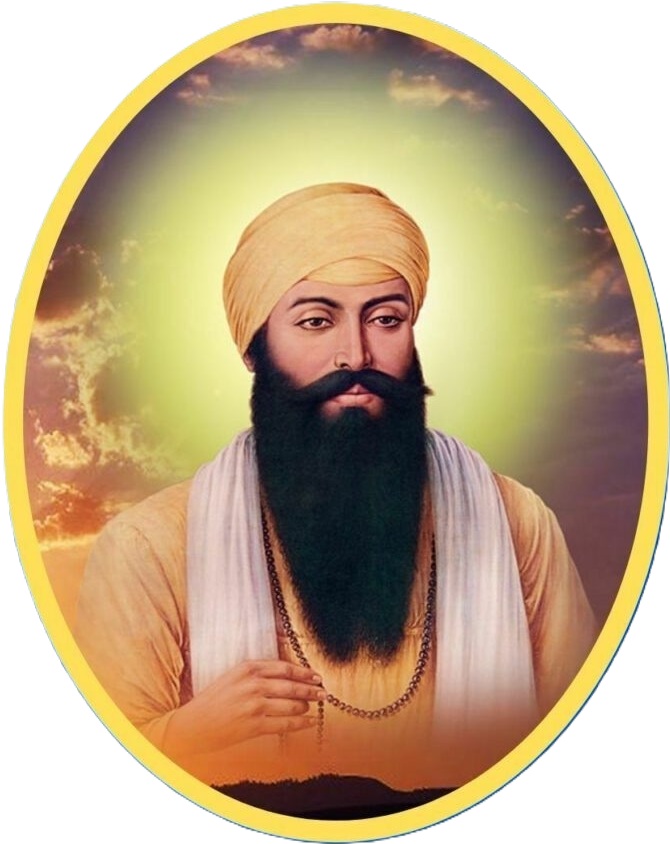
Guru Ram Das Ji
Founder of Amritsar and composer of the Laavan, the sacred hymns of Sikh marriage.
- Parkash
- 24 September 1534 (Katak Vadi 2, Samvat 1591)
Chuna Mandi, Lahore, present-day Pakistan - Gurgaddi
- 1 September 1574 (Bhadon Sudi 15, Samvat 1631), installed by Guru Amar Das Ji
Goindwal Sahib - Joti Jot
- 1 September 1581 (Bhadon Sudi 3, Samvat 1638)
Goindwal Sahib, on the river Beas - Guruship
- 1574–1581
Jeevni (Life Story)
Guru Ram Das Ji, the Fourth Master, took Parkash on 24 September 1534 in the Chuna Mandi quarter of Lahore, then the capital of the Punjab under the Mughals. His father, Baba Hari Das Ji, was a Sodhi Khatri trader of modest means, and his mother was Mata Daya Kaur Ji, also remembered as Mata Anup Devi Ji. As the first-born son he was called Jetha, the eldest, and the name stayed with him until he became Guru. His childhood was marked by hardship: both parents passed away when he was about seven years old, and his maternal grandmother took the orphan to her village of Basarke, south-west of the present city of Amritsar. There, to support himself and the old woman, young Jetha Ji went out each day into the lanes with a basket of boiled grams, ghungnian, which he sold for a few coppers, and from which he gave freely to any hungry sadhu or child he met.
Basarke was the birthplace of Bhai Amar Das Ji, who had by then become a Sikh of Guru Angad Dev Ji and who, when he visited the village, noticed the gentle, dutiful boy. When Bhai Amar Das Ji was commanded to found the town of Goindwal on the Beas around 1546, Bhai Jetha Ji, then about twelve, moved there with his grandmother. He continued to sell grams by day and spent the evenings in the Sangat, serving in the Langar and carrying earth and bricks for the buildings of the new town. He asked for nothing and accepted every task. When Guru Amar Das Ji assumed the Guruship in 1552 and made Goindwal his seat, Bhai Jetha Ji became one of the inner circle of his servants, distinguished by his sweetness of disposition and unquestioning obedience.
In 1553 Guru Amar Das Ji and Mata Mansa Devi Ji were seeking a match for their younger daughter Bibi Bhani Ji. Tradition records that when the matchmaker asked what kind of husband they desired, Mata Mansa Devi Ji pointed to the young man selling grams at the gate and said, one like him; Guru Ji replied that there could be only one like him, for he was unique in his devotion. So Bibi Bhani Ji was married to Bhai Jetha Ji, and instead of taking his bride to Lahore, he remained at Goindwal in the service of his father-in-law, now also his Guru. Three sons were born to them: Baba Prithi Chand Ji in 1558, Baba Mahadev Ji in 1560 and, on 15 April 1563, Sahibzada Arjan Dev Ji, whose grandfather foretold that he would be the ship carrying the Bani across the ocean of the world. Bhai Jetha Ji laboured with the other Sikhs in the digging of the Baoli Sahib between 1556 and 1559, and Bibi Bhani Ji's devotion to her father is remembered in the tradition that she held up the broken leg of his stool with her hand while he was absorbed in meditation, till the blood ran.
Guru Amar Das Ji came to rely upon Bhai Jetha Ji in matters of consequence. When the Brahmins and conservative Khatris of the Punjab complained to Akbar at Lahore that the Guru at Goindwal was leading the people away from caste, the Vedas and the sacred thread, Guru Ji sent Bhai Jetha Ji to represent him. Before the emperor he explained that the Guru taught only the remembrance of the One God, honest labour and sharing, that the Langar fed all alike because all were children of the same Father, and that the Gurus' hymns were in the language of the people so that all might understand them. Akbar was satisfied and dismissed the complaint. Around 1570 Guru Amar Das Ji entrusted Bhai Jetha Ji with a far-sighted project: to acquire land in the low country some forty kilometres to the west, near the villages of Tung, Gilwali and Sultanwind, and to begin a new settlement around a tank. Tradition holds that the land was purchased from the villagers of Tung for seven hundred Akbari rupees, and other traditions associate it with the jagir granted by Akbar to Bibi Bhani Ji. Work began on the Santokhsar tank and a small settlement, Guru ka Chak, grew up around it.
In 1574 Guru Amar Das Ji, now in his ninety-sixth year, prepared to pass on the Light. His sons, Baba Mohan Ji and Baba Mohri Ji, were not chosen, and he tested his two sons-in-law by asking them to build earthen platforms, tharas, for him to sit on. Each time one was finished he found fault and had it pulled down. Bhai Rama Ji, husband of Bibi Dani Ji, gave up after a few attempts, saying the Guru was old and did not know his own mind. Bhai Jetha Ji built his platform seven times, each time folding his hands and saying that he was a fool and the Guru alone knew what was right; he would build it a hundred times if commanded. Guru Amar Das Ji embraced him, and on 1 September 1574 (Bhadon Sudi 15, Samvat 1631), at Goindwal, placed five paise and a coconut before him, bowed to him as Guru Ram Das Ji, and had Baba Buddha Ji apply the tilak. The same day Guru Amar Das Ji merged into the Divine Light.
Guru Ram Das Ji soon moved his seat from Goindwal to the new settlement, which the Sikhs called Ramdaspur or Chak Ramdas, the town of Ram Das. In 1577, the date traditionally given for the founding of the city, he began the excavation of a great tank, the Amrit Sarovar, the Pool of Nectar, from which the city would later take the name Amritsar. Baba Buddha Ji supervised the work and the Sikhs came from every quarter to dig and carry earth as an act of seva. Guru Ji built his own dwelling, the Guru Mahal, beside the tank and laid out a market, inviting traders, bankers and craftsmen of fifty-two trades from the towns of Patti, Kasur and elsewhere to settle there, so that the holy city would also be a prosperous one. This market, the Guru ka Bazaar, still bears his memory. To fund so vast an undertaking Guru Ji developed the Manji system of Guru Amar Das Ji into the Masand system: authorised representatives of the Guru, the Masands, preached in the Sangats, instructed new Sikhs, and brought the voluntary offerings of the faithful to Ramdaspur each Baisakhi and Diwali.
In his seven years of Guruship Guru Ram Das Ji composed 638 hymns in thirty ragas, more than any Guru before him save Guru Nanak Dev Ji, and introduced ragas such as Kalyan and Nat Narayan into the Gurbani. His hymns are marked by tender longing for the Beloved and by the imagery of marriage. The Laavan, four stanzas in Raag Suhi describing the four rounds of the soul's wedding to the Lord, became the heart of the Sikh marriage rite, the Anand Karaj, in which the couple circle Sri Guru Granth Sahib as each Laav is sung. His So Purakh in Raag Asa opens the evening Rehras Sahib; his Ghorian turn the wedding songs of the bridegroom's horse into praise of the soul's journey to God; his Pahre, Karhale and Vanjara speak to the trader and traveller of the soul; and his eight Vars, more than any other Guru composed, were set to the tunes of the folk ballads of the Punjab. His hymn on the daily discipline of the Sikh, 'Gur Satgur ka jo Sikh akhae, so bhalke uth Har Naam dhiavai', rising early to bathe and meditate on the Name, remains the charter of Sikh daily life.
The Guru's humility disarmed even old rivalries. Baba Sri Chand Ji, the venerable elder son of Guru Nanak Dev Ji and head of the Udasi order of ascetics, visited Ramdaspur. Observing the Guru's long beard, he asked, half in jest, why he had let it grow so long. Guru Ram Das Ji answered that it was to wipe the dust from the feet of holy men like him, and bent to do so. Baba Sri Chand Ji caught him up and embraced him, declaring that it was by such humility that the Guruship had gone to the house of Lehna and not to the sons of Nanak, and the Udasis were thereafter at peace with the Gurus. In these years, too, Bhai Gurdas Ji, the learned nephew of Guru Amar Das Ji, placed himself under Guru Ram Das Ji's instruction and was sent to Agra to preach among the Sangats of the Doab, beginning the career of the greatest expositor of Sikh doctrine, and Bhai Buddha Ji, now in his seventies, remained the pillar of the community at Ramdaspur.
The question of succession brought sorrow to the Guru's own house. His eldest son, Baba Prithi Chand Ji, was capable and ambitious and had taken charge of the Guru's household and treasury, and he expected the Guruship as his right. Baba Mahadev Ji had turned to the life of a recluse. The youngest, Sahibzada Arjan Dev Ji, was gentle and wholly absorbed in devotion. When an invitation came to the wedding of a cousin at Lahore, the son of Guru Ji's relative Bhai Sahari Mall, Prithi Chand Ji refused to go lest his father should install Arjan Dev in his absence, and Guru Ji sent Sahibzada Arjan Dev Ji instead, with instructions to remain at Lahore and serve the Sangat there until recalled. Months passed. Longing for the Guru's presence, Sahibzada Arjan Dev Ji wrote a letter in verse, 'Mera man lochai Gur darsan tai', my mind longs for the sight of the Guru, and then a second; both were intercepted by Prithi Chand Ji. The third, marked by the Sahibzada as the third, reached Guru Ji through Baba Buddha Ji, and the whole matter came to light. Guru Ram Das Ji recalled his son at once, and when Sahibzada Arjan Dev Ji, at his father's bidding, added a fourth stanza, 'Bhag hoa Gur sant milaya', by good fortune I have met the Guru, the saint, Guru Ji declared him the ship of the Bani and his heir.
Guru Ram Das Ji returned to Goindwal and there, on 1 September 1581 (Bhadon Sudi 3, Samvat 1638), he placed the five paise and coconut before Sahibzada Arjan Dev Ji, bowed to him, and had the aged Baba Buddha Ji apply the tilak, installing him as Guru Arjan Dev Ji, the Fifth Master. He counselled Prithi Chand Ji to accept his brother, telling him that the Guruship was a gift of the Divine and not an inheritance. The same day Guru Ram Das Ji merged into the Divine Light at Goindwal, in his forty-seventh year, having held the Guruship for exactly seven years. His Guruship was the shortest of the first five Masters, yet it gave the Sikhs their holiest city, their marriage rite and the organisation that would carry them into the next century. Mata Bhani Ji survived him until 1598 and lived to see her son raise the Harmandir Sahib on the Sarovar her husband had dug.
Journeys
Guru Ram Das Ji's life was spent in the central Punjab, between Lahore, Basarke, Goindwal and the city he founded. Born in Chuna Mandi in the old walled city of Lahore, where Gurdwara Janam Asthan Guru Ram Das Ji now stands, he was taken as an orphan to his grandmother's village of Basarke, and from there to Goindwal around 1546. As Bhai Jetha Ji he travelled to Lahore on behalf of Guru Amar Das Ji to answer the charges laid before Akbar's court, and tradition holds that he also accompanied Guru Amar Das Ji on his tour to Kurukshetra and Haridwar. His most consequential journey was the forty kilometres west from Goindwal to the low-lying land near the villages of Tung, Gilwali and Sultanwind, where, around 1570, he began the settlement that became Ramdaspur and finally Amritsar. There he dug first the Santokhsar and then, from 1577, the Amrit Sarovar, and he moved his seat there after becoming Guru. The site lay on the old route between Lahore and Delhi and near the trade roads to Kashmir and Kabul, and Guru Ji drew to it settlers from Patti, Kasur and other towns of the Majha. He returned to Goindwal in his final days and merged into the Divine Light there. Through his Masands his message travelled far further than he did, to the Sangats of Punjab, Kabul, Kashmir, Agra and beyond, and Bhai Gurdas Ji's mission to Agra was undertaken at his command.
Teachings
Guru Ram Das Ji taught that the human soul is the bride and the Lord the Bridegroom, and that the whole purpose of life is the loving union of the two. In the Laavan he describes the four stages of this union: the first round, in which the soul accepts the Guru's Word and the duties of the householder; the second, in which the fear of the ego departs and the Lord is seen pervading all; the third, in which detachment from the world and love of the Lord fill the mind in the company of the holy; and the fourth, in which the soul attains the Lord and bliss is complete. He taught that the Guru's Sikh should rise in the last watch of the night, bathe, meditate on the Name, and then go about the world remembering the Lord with every breath and every morsel, and that such a Sikh earns the Guru's blessing. He emphasised seva as the surest means of grace, as his own life had shown, and humility as the mark of greatness. His hymns speak of the Lord as the beloved friend whom the soul longs to meet, and of the Sangat as the place where that meeting is made possible. He also taught that the Guru's house is sustained by the voluntary offerings of the Sikhs, given through trusted representatives, so that the community's institutions remain its own.
Timeline
-
1534
24 September: Parkash of Bhai Jetha Ji at Chuna Mandi, Lahore, to Baba Hari Das Ji and Mata Daya Kaur Ji; as the first-born he was called Jetha.
-
c. 1541
Orphaned at about seven years of age by the death of both parents; taken by his maternal grandmother to her village of Basarke, the native place of Guru Amar Das Ji.
-
c. 1541–1546
Earned a living for himself and his grandmother by selling boiled grams (ghungnian) in the streets, and met Guru Amar Das Ji, then still Bhai Amar Das Ji, who visited Basarke.
-
c. 1546–1547
Moved with his grandmother to the new settlement of Goindwal, where he sold grams by day and served in the Langar and at the construction of the town by night.
-
1552
Guru Amar Das Ji assumed the Guruship and settled at Goindwal; Bhai Jetha Ji became one of his most devoted servants.
-
1553
Marriage to Bibi Bhani Ji, younger daughter of Guru Amar Das Ji, after Mata Mansa Devi Ji pointed to the young man selling grams at the gate as resembling the match she wished for; the couple remained at Goindwal in the Guru's service, where Baba Prithi Chand Ji was born in 1558 and Baba Mahadev Ji in 1560.
-
1556–1559
Served in the digging of the Baoli Sahib at Goindwal, carrying earth in baskets on his head beside the other Sikhs.
-
1563
15 April: Parkash of Sahibzada Arjan Dev Ji at Goindwal, the youngest son, cherished by his grandfather Guru Amar Das Ji.
-
c. 1567
Sent by Guru Amar Das Ji to the court of Akbar at Lahore to answer the complaints of Brahmins and Khatris against the Guru's teachings; his replies satisfied the emperor and the complaint was dismissed.
-
c. 1570
At Guru Amar Das Ji's direction, acquired land near the villages of Tung, Gilwali and Sultanwind, and began the settlement of Guru ka Chak with the digging of the Santokhsar tank.
-
1574
Tested by Guru Amar Das Ji with the building of earthen platforms, which he rebuilt seven times in obedience; chosen as successor over his elder brother-in-law Bhai Rama Ji.
-
1574
1 September: Installed as Guru Ram Das Ji at Goindwal by Guru Amar Das Ji, with Baba Buddha Ji applying the tilak; Guru Amar Das Ji merged into the Divine Light the same day.
-
1574–1577
Moved the seat of Guruship to Guru ka Chak, which came to be called Ramdaspur, Chak Ramdas or Chak Guru; the Sangats were organised under Masands to support the work.
-
1577
Excavation of the Amrit Sarovar, the Pool of Nectar, begun on the site of the present Harmandir Sahib; the traditional founding date of the city of Amritsar.
-
c. 1577–1580
Invited merchants and artisans of fifty-two trades from Patti, Kasur and other towns to settle at Ramdaspur, establishing the Guru ka Bazaar; the town grew into a thriving centre.
-
c. 1579
Baba Sri Chand Ji, son of Guru Nanak Dev Ji, visited Ramdaspur; asked why he had grown so long a beard, Guru Ji replied that it was to wipe the feet of holy men like him, and bent to do so; Baba Sri Chand Ji embraced him and acknowledged the Guruship.
-
c. 1579–1581
Bhai Gurdas Ji, nephew of Guru Amar Das Ji, joined Guru Ji's service and was sent to Agra as a preacher; Bhai Buddha Ji and other elders continued to serve at the new town.
-
c. 1580
Sahibzada Arjan Dev Ji was sent to Lahore to attend the wedding of Bhai Sahari Mall's son and remained there at Guru Ji's command for about two years, composing the letters of longing beginning 'Mera man lochai Gur darsan tai'.
-
1581
Baba Prithi Chand Ji, the eldest son, intercepted the letters; when the third was delivered Guru Ji recalled Sahibzada Arjan Dev Ji and, hearing him complete the hymn with a fourth stanza, declared him the ship of the Bani and his successor.
-
1581
1 September (Bhadon Sudi 3, Samvat 1638): At Goindwal Guru Ram Das Ji installed Sahibzada Arjan Dev Ji as Guru Arjan Dev Ji, with Baba Buddha Ji applying the tilak, and merged into the Divine Light the same day, aged 46.
Legacy
Guru Ram Das Ji's most visible legacy is the city of Amritsar, the spiritual capital of the Sikhs, which grew from the tank he excavated in 1577 and whose central shrine, Sri Harmandir Sahib, his son built in its midst; the Sarovar is still called Amrit Sarovar and the city remembers its founder in the name Ramdaspur, in the Guru ka Bazaar and in Gurdwara Guru ke Mahal, his home. Every Sikh marriage since has been solemnised with his Laavan, so that his words accompany every Sikh family at its founding, and his So Purakh is sung in every Gurdwara at dusk. The Masand system he organised sustained the Panth financially and administratively for over a century until it was reformed by Guru Gobind Singh Ji, and the welcome he gave to Bhai Gurdas Ji and his continued trust in Baba Buddha Ji set the stage for the compilation of the Adi Granth. The humility by which the orphan gram-seller of Lahore became Guru, and by which the Guru stooped to wipe the feet of Baba Sri Chand Ji, is held up to Sikhs as the essence of greatness, and his hymn on the daily life of the Sikh is the simplest and most complete statement of Sikh practice. From him descended all six Gurus who followed, down to Guru Gobind Singh Ji, so that the Sodhi house of Guru Ram Das Ji carried the Light of Guru Nanak Dev Ji to its completion.