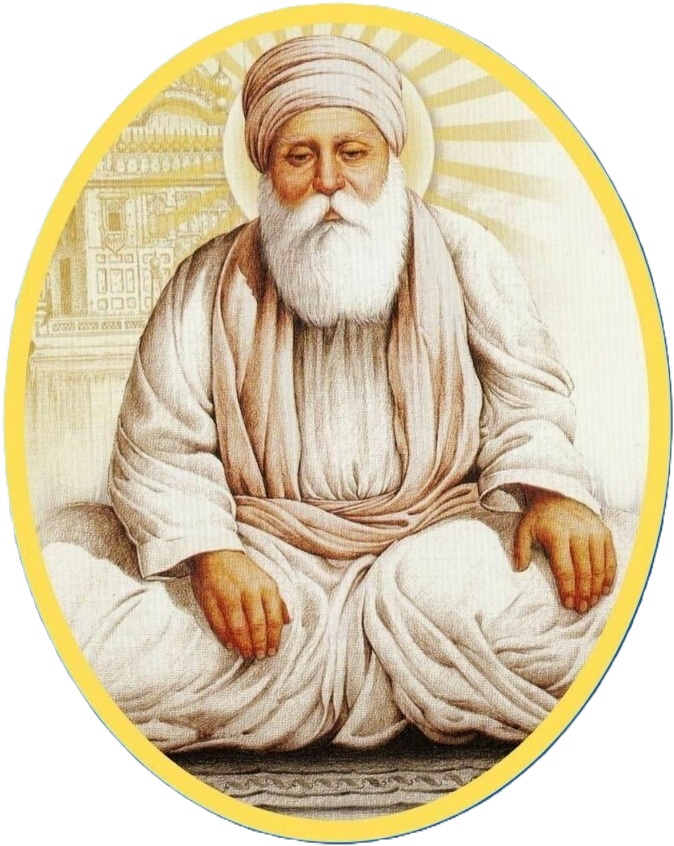
Guru Amar Das Ji
Refuge of the homeless, who built Goindwal and gave the Panth the Anand Sahib.
- Parkash
- 5 May 1479 (Vaisakh Sudi 14, Samvat 1536)
Basarke (Basarke Gillan), near Amritsar, Punjab, India - Gurgaddi
- 29 March 1552 (Chet Sudi 4, Samvat 1609), installed by Guru Angad Dev Ji at the age of 73
Khadur Sahib - Joti Jot
- 1 September 1574 (Bhadon Sudi 15, Samvat 1631)
Goindwal Sahib, on the river Beas, Tarn Taran district, Punjab - Guruship
- 1552–1574
Jeevni (Life Story)
Guru Amar Das Ji, the Third Master, took Parkash on 5 May 1479 at Basarke, a village a few kilometres south-west of present-day Amritsar, ten years after the Parkash of Guru Nanak Dev Ji. He was the eldest son of Baba Tej Bhan Bhalla Ji, a farmer and small trader of the Bhalla Khatri clan, and Mata Lachhmi Ji. Around 1502 he was married to Mata Mansa Devi Ji, daughter of Bhai Devi Chand Bahl of Sankhatra in Sialkot district, and the couple were blessed with two sons, Baba Mohan Ji and Baba Mohri Ji, and two daughters, Bibi Dani Ji and Bibi Bhani Ji, the youngest, born in 1535. Bhai Amar Das Ji followed his father's calling and was known as a pious Vaishnava: he kept the fasts, worshipped at the family shrine, and each year walked barefoot to bathe in the Ganga at Haridwar. He made this pilgrimage some twenty times. Returning from the last of them, he fell into conversation with a sadhu who, on learning that Bhai Amar Das Ji had no spiritual preceptor, declared that he had eaten food from the hands of a man without a Guru and had thereby sinned. The words struck Bhai Amar Das Ji deeply, and he prayed to be led to a true Guru.
The answer came in his own household. His brother's son, Bhai Jasoo, had been married to Bibi Amro Ji, the daughter of Guru Angad Dev Ji, and she had brought with her from Khadur the habit of singing the hymns of Guru Nanak Dev Ji at dawn. One morning in 1540 Bhai Amar Das Ji, then sixty-one years old, heard her singing a shabad of Guru Nanak in Raag Maru and was overcome. He asked her whose words they were and where their author's successor lived, and begged her to take him there. Bibi Amro Ji led him to Khadur. When Guru Angad Dev Ji, who was his junior by twenty-five years and related to him by marriage, rose to receive the father-in-law of his daughter, Bhai Amar Das Ji would not permit it; he fell at the Guru's feet and asked only to be accepted as a Sikh. Guru Angad Dev Ji gave him the Name, and from that day he lived at Khadur as the humblest of servants.
For twelve years Bhai Amar Das Ji's seva at Khadur was unceasing. Every night he rose long before dawn and walked three kilometres to the river Beas to fetch a pitcher of fresh water for the Guru's bath, carrying it on his head with his face always turned toward the Guru's house so as not to turn his back on his Master. During the day he worked in the Langar, cleaned the Guru's dharamsal and served the Sangat, eating only when all had been fed. He was mocked by his relatives for serving a man of a younger generation and lower clan; he answered that he served the Light, not the body. In 1546 Guru Angad Dev Ji sent him to build a new town at Goindwal on the Beas, on land offered by a devotee named Goinda, so situated that travellers on the Delhi to Lahore road would pass through it; Bhai Amar Das Ji supervised the building by day and still returned to carry the Guru's water each night. One stormy night in about 1551, blinded by rain, he stumbled over a peg at a weaver's hut and fell, but did not let the pitcher spill. The weaver's wife, hearing the noise, said it must be Amru the homeless, who had no shelter and wandered the nights. When the words were reported to Guru Angad Dev Ji, he replied that Amar Das was not homeless but the home of the homeless, the refuge of the shelterless, the honour of the dishonoured, the strength of the weak. Shortly afterwards the Guru began to prepare him for the Guruship.
On 29 March 1552, at Khadur Sahib, Guru Angad Dev Ji placed five paise and a coconut before Bhai Amar Das Ji, bowed to him, and had Baba Buddha Ji anoint him as Guru Amar Das Ji, the Third Master, aged seventy-three. Guru Angad Dev Ji merged into the Divine Light the same day. The sons of Guru Angad Dev Ji, Baba Dasu Ji and Baba Datu Ji, resented the choice, and Guru Amar Das Ji, in obedience to his Master's instruction and to avoid strife, moved his seat to Goindwal. Baba Datu Ji followed him there, and one day, in the full Sangat, kicked the aged Guru from his seat, declaring that he was a mere servant of yesterday. Guru Ji rose, touched Datu's foot and said that his old bones were hard and must have hurt it. He then quietly withdrew to Basarke, shut himself in a room, and placed a notice on the door that whoever opened it was no Sikh of his. Baba Buddha Ji, leading the anxious Sangat, broke through the back wall of the room rather than open the door, and begged him to return. Guru Ji relented, and Goindwal became, for twenty-two years, the heart of the Panth. Gurdwara San Sahib at Basarke marks the place.
Guru Amar Das Ji built Goindwal into the first great centre of Sikh pilgrimage. In 1556 he began the Baoli Sahib, a stepped well with eighty-four steps descending to the water, under the supervision of Baba Buddha Ji; it was completed in 1559. Tradition holds that one who recites the Japji Sahib on each of the eighty-four steps and bathes is released from the eighty-four lakh cycles of birth. More important than this promise was the open invitation: here the untouchable and the Brahmin drew water from the same well and bathed at the same ghat. Guru Ji fixed the festivals of Baisakhi, Maghi and Diwali as the days when the Sikhs should gather at the Guru's seat, so that the community had its own calendar of assembly, and he laid down Sikh forms for the ceremonies of birth, marriage and death, in which the Bani of the Gurus replaced the Sanskrit rites of the Brahmins. The Anand Sahib came to be sung at every one of these occasions, as it still is.
The Langar at Goindwal was the practical expression of Guru Ji's teaching. He made it a rule that no one, whatever rank or faith, could see him until they had first sat in the Pangat and eaten with the common people, hence the saying 'Pehle Pangat, pachhe Sangat'. When the emperor Akbar came to Goindwal around 1567 on his way to Lahore, he too sat in the row on the ground and ate the simple food before his audience with the Guru. Impressed, he offered a grant of villages to maintain the kitchen; Guru Ji declined, saying the Langar was sustained by the Sikhs' own offerings and should depend on no ruler, though Akbar later settled a jagir upon Bibi Bhani Ji. From Goindwal Guru Ji organised the expanding Panth: he divided the country into twenty-two Manjis, or dioceses, each under a trusted Sikh who preached, collected offerings and settled disputes, among them Bhai Sawan Mall, Bhai Paro and Bhai Allah Yar, and he appointed women preachers, the Piris, to carry the teaching to women. He ordered the collection of the Bani of the first three Gurus and of the Bhagats such as Kabir Ji, Namdev Ji and Ravidas Ji into volumes written by his grandson Bhai Sahansram, the Goindwal Pothis, which Guru Arjan Dev Ji would later draw upon.
Guru Amar Das Ji was a fearless reformer of social custom. He forbade his Sikhs the practice of Sati, by which widows were burned on their husbands' pyres, declaring in Raag Suhi that the true Sati is not she who burns with her husband's body but she who dies of the pain of separation from the Lord and lives in contentment and virtue. He encouraged widows to remarry, condemned the veiling of women in purdah and would not receive a woman who came veiled, and he permitted marriages across caste lines within the Sangat. He discouraged the drinking of liquor and the custom of elaborate mourning. The Brahmins and orthodox Khatris of the Punjab, alarmed, carried complaints to Akbar at Lahore that the Guru had abandoned the Vedas, the caste rules and the sacred thread; Guru Ji sent his son-in-law Bhai Jetha Ji to answer them, and Akbar, satisfied that the Guru taught only love of God and service of humanity, dismissed the charge. At Guru Ji's request the emperor also abolished the tax levied on Hindu pilgrims at Haridwar and Kurukshetra, which Guru Ji himself visited with a great following of Sikhs.
Guru Ji's compositions, 907 in number, are among the most beloved in Sri Guru Granth Sahib. The Anand Sahib, the Song of Bliss, in forty pauris in Raag Ramkali, was composed, according to tradition, when a grandson, Anand, was born to Baba Mohri Ji; its first five and final pauris are recited daily in the Nitnem and at the conclusion of every Sikh gathering. His four Vars, in Gujri, Suhi, Ramkali and Maru, and his Alahunian in Raag Wadhans, which replaced the wailing of mourners with the remembrance of God, gave the Sikhs their own voice for grief and joy. In his hymns he returned again and again to the Gurmukh, the person turned toward the Guru, who lives in the world without being bound by it. In 1563 his grandson Arjan Dev was born at Goindwal to Bibi Bhani Ji and Bhai Jetha Ji, and Guru Ji is remembered to have said of him, 'Dohita Bani da bohitha', this grandson will be the ship that carries the Bani across.
Bhai Jetha Ji, a Sodhi of Lahore who had come to Goindwal as a youth and sold boiled grams in its streets while serving at the Baoli, had married Bibi Bhani Ji in 1553 and had grown ever closer to the Guru through his humility. Guru Ji directed him to acquire land some forty kilometres to the west, near Tung and Sultanwind, and to begin a settlement with a tank, Guru ka Chak, the future Amritsar; the digging of Santokhsar began around 1570. When the time came to choose a successor, Guru Ji passed over his sons, Baba Mohan Ji, who had turned to seclusion, and Baba Mohri Ji, and tested his two sons-in-law by asking each to build an earthen platform. Bhai Rama Ji, husband of Bibi Dani Ji, grew impatient after two or three attempts; Bhai Jetha Ji demolished and rebuilt his seven times, saying each time that he was a fool and the Guru alone knew what was right. On 1 September 1574 (Bhadon Sudi 15, Samvat 1631), Guru Amar Das Ji placed the five paise and coconut before Bhai Jetha Ji, bowed, and had Baba Buddha Ji anoint him as Guru Ram Das Ji, the Fourth Master.
Guru Amar Das Ji then gathered his family and the Sangat, and in the composition known as the Sadd, recorded in Sri Guru Granth Sahib by his great-grandson Baba Sundar Ji, he instructed that no one should weep after his departure, that no Brahmins should be called and no lamps floated, but that the Sangat should sing the Kirtan of the Lord and read the Bani. He directed Baba Mohri Ji and the others to accept Guru Ram Das Ji as the Guru, and they bowed to him. On the same day, 1 September 1574, in his ninety-sixth year, Guru Amar Das Ji merged into the Divine Light at Goindwal Sahib, having served as Guru for twenty-two years and five months. Gurdwara Baoli Sahib and Gurdwara Chubara Sahib at Goindwal, with the Guru's own room, mark the place where he lived and departed. Having come to the Guru's door at sixty-one as a homeless old man, he had become the Guru of the homeless, and left behind a Panth with its own town, its own tirath, its own festivals, its own ceremonies and its own song of bliss.
Journeys
Before he became a Sikh, Bhai Amar Das Ji travelled on foot to Haridwar on the Ganga about twenty times, a pilgrimage of several hundred kilometres each way, and it was on returning from one of these that he was moved to seek a living Guru. From 1540 his daily journey was the three-kilometre path between Khadur and the river Beas, walked in darkness each night with a pitcher of water on his head for Guru Angad Dev Ji's bath, and from 1546 the road between Khadur and the new settlement of Goindwal. As Guru, he made Goindwal his seat, but he undertook a notable tour of the Hindu places of pilgrimage: with a large following of Sikhs he visited Kurukshetra at the time of the solar eclipse fair and then Haridwar, teaching the assembled pilgrims the path of the Name and the futility of empty ritual. At his request Akbar remitted the pilgrim tax levied on Hindus at these places. Guru Ji also visited Lahore and his birthplace Basarke, where Gurdwara San Sahib marks the room in which he secluded himself after Baba Datu Ji's assault, and he sent his 22 Manjidars out to preach across Punjab, the hill states, Kashmir and as far as Kabul and Bengal. Goindwal itself, standing on the Grand Trunk Road between Delhi and Lahore at the ferry across the Beas, became the destination of pilgrims from all directions, and travellers of every faith, including Akbar himself, broke their journey at the Guru's Langar.
Teachings
Guru Amar Das Ji taught that the Lord is realised through the Shabad, the Word of the Guru, by which the fire of desire is quenched and the mind becomes still and blissful. The Anand Sahib describes this inner joy: 'Anand bhaia meri maae, Satguru mai paia', Bliss has arisen, O my mother, for I have found the True Guru. He emphasised that this bliss is open to every caste and both sexes without distinction, and he put the teaching into practice by requiring all who came to him to first eat together in the Pangat, by condemning the burning of widows on the pyre and the veiling of women, and by appointing women as preachers. He declared that the Guru's true disciple is one who, rising early, bathes, meditates on the Name, sings the Guru's praises and serves others with humility, and that no one is high or low except by their deeds. He warned against the pride of pilgrimage, fasting and caste, saying that the Lord dwells in the heart and not in the Ganga. Above all he taught the dignity of the humble: having himself been called a homeless old man, he made the Guru's house a refuge for the shelterless, the orphan and the outcaste.
Timeline
-
1479
5 May: Parkash of Guru Amar Das Ji at Basarke near Amritsar, eldest son of Baba Tej Bhan Bhalla Ji and Mata Lachhmi Ji.
-
c. 1502
Marriage to Mata Mansa Devi Ji of Sankhatra; the couple were blessed with Baba Mohan Ji, Baba Mohri Ji, Bibi Dani Ji and Bibi Bhani Ji (born 1535).
-
c. 1520–1540
A devout Vaishnava, Bhai Amar Das Ji made some twenty annual pilgrimages on foot to Haridwar; on the last journey a sadhu told him it was a sin to have no Guru, which set him searching.
-
1540
Heard Bibi Amro Ji, daughter of Guru Angad Dev Ji and wife of his nephew Bhai Jasoo, singing a hymn of Guru Nanak Dev Ji at Basarke; asked her to take him to Khadur, where he became a Sikh of Guru Angad Dev Ji at the age of 61.
-
1540–1552
Twelve years of seva at Khadur: rising at midnight to carry water from the Beas for the Guru's bath, serving in the Langar, cleaning the dharamsal, and never sleeping on a bed.
-
1546
Sent by Guru Angad Dev Ji to found Goindwal on the Beas, on land offered by Goinda Marwaha; Bhai Amar Das Ji built the town and returned to Khadur each morning to serve.
-
1551
Birth at Goindwal of Bhai Gurdas Ji, son of Bhai Amar Das Ji's brother's family, who would later write out the Adi Granth.
-
c. 1551
One stormy night Bhai Amar Das Ji stumbled against a weaver's peg while carrying water; the weaver's wife called him 'Amru nithavan', homeless Amru; Guru Angad Dev Ji declared him 'nithavan da thav', the refuge of the shelterless.
-
1552
29 March: Installed as Guru Amar Das Ji at Khadur Sahib by Guru Angad Dev Ji, with Baba Buddha Ji applying the tilak; Guru Angad Dev Ji merged into the Divine Light the same day.
-
1552
Baba Datu Ji, son of Guru Angad Dev Ji, kicked Guru Ji at Goindwal in anger at being passed over; Guru Ji rubbed Datu's foot, saying his old bones must have hurt it, and retired to Basarke, where Baba Buddha Ji found him and brought him back.
-
1553
Marriage of Bibi Bhani Ji to Bhai Jetha Ji (Guru Ram Das Ji) of Lahore, who had been living and serving at Goindwal; some sources give 18 February 1554.
-
1556
Work begun on the Baoli Sahib at Goindwal under the supervision of Baba Buddha Ji, a well with 84 steps descending to the water.
-
1559
Completion of the Baoli Sahib; Goindwal became the first Sikh tirath (place of pilgrimage) open to all, and Guru Ji fixed Baisakhi, Maghi and Diwali as days of assembly.
-
1563
15 April: Parkash of Sahibzada Arjan Dev Ji at Goindwal, youngest son of Bibi Bhani Ji and Bhai Jetha Ji; Guru Ji declared, 'Dohita Bani da bohitha', the grandson will be the ship of the Bani.
-
c. 1565–1570
Guru Ji organised the Panth into 22 Manjis under trusted Sikhs such as Bhai Sawan Mall and Bhai Paro, and appointed women (Piris) to preach among women; composed the Anand Sahib on the birth of his grandson Anand, son of Baba Mohri Ji.
-
c. 1567
Emperor Akbar visited Goindwal on his way to Lahore, sat in the Pangat and ate the Langar with the common people before meeting Guru Ji, and offered a grant of villages, which Guru Ji declined for himself; a jagir was later granted to Bibi Bhani Ji.
-
c. 1567–1570
Brahmins and Khatris complained to Akbar at Lahore that the Guru had abandoned caste and ritual; Bhai Jetha Ji represented Guru Ji at court and Akbar dismissed the complaint; Guru Ji toured Kurukshetra and Haridwar, with Akbar remitting the pilgrim tax at his request.
-
c. 1570
Guru Ji directed Bhai Jetha Ji to acquire land and begin a new settlement, Guru ka Chak, at the site that would become Ramdaspur and later Amritsar; work on the Santokhsar tank was begun.
-
1574
Guru Ji tested his sons-in-law Bhai Rama Ji and Bhai Jetha Ji by having them build earthen platforms; Bhai Jetha Ji rebuilt his seven times without complaint and was chosen successor.
-
1574
1 September (Bhadon Sudi 15, Samvat 1631): At Goindwal Guru Ji installed Bhai Jetha Ji as Guru Ram Das Ji, with Baba Buddha Ji applying the tilak, forbade mourning in the Sadd of Baba Sundar Ji, and merged into the Divine Light aged 95.
Legacy
Guru Amar Das Ji transformed the Sikh community from a devotional fellowship into an organised Panth with its own sacred centre, its own calendar and its own institutions. The Baoli Sahib at Goindwal was the first Sikh tirath, and the Manji system he devised was the first ecclesiastical organisation of the Sikhs, later developed by Guru Ram Das Ji into the masand system that would fund the building of Amritsar and the Harmandir Sahib. His rule of Pehle Pangat, pachhe Sangat remains the law of every Gurdwara, where no visitor is too great to sit on the floor with the humblest. His stand against Sati and purdah and his appointment of women preachers were centuries ahead of their time and set the pattern for the equal place of women in Sikh worship. The Anand Sahib is sung at every Sikh wedding, every Akhand Path and every gathering, and the Goindwal Pothis he commissioned were the scriptural bridge between Guru Nanak Dev Ji and the Adi Granth of his grandson Guru Arjan Dev Ji. Goindwal Sahib, with the Baoli Sahib, remains a major place of pilgrimage, and his life, from the pitcher carried in the dark to the Guruship assumed at seventy-three, is held before every Sikh as proof that it is never too late to find the Guru and that seva is the surest path to grace.