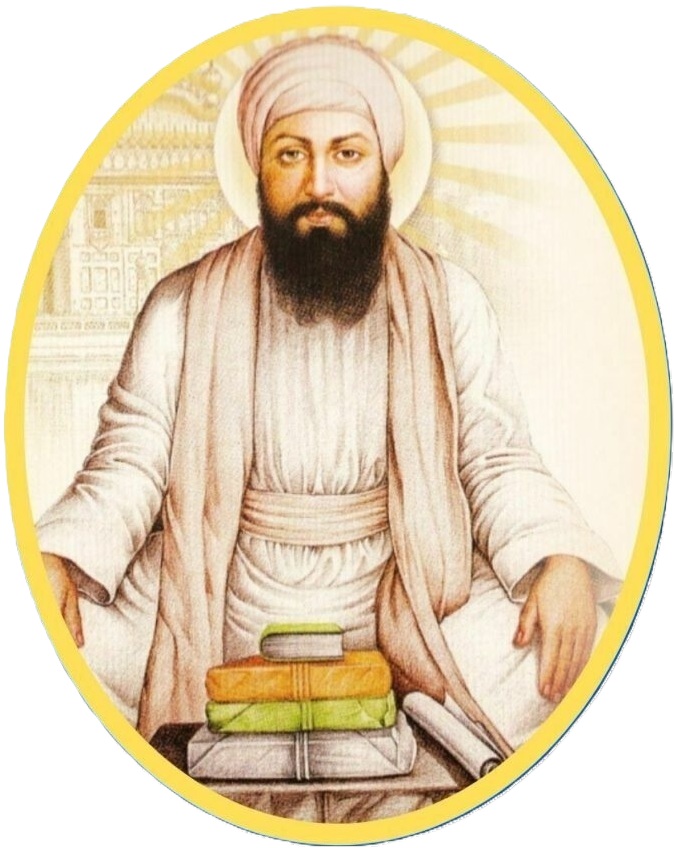
Guru Angad Dev Ji
The perfect disciple who became Guru, and gave the Sikhs the Gurmukhi script.
- Parkash
- 31 March 1504 (Vaisakh Vadi 1, Samvat 1561)
Matte di Sarai (now Sarai Naga), near Muktsar, Punjab, India - Gurgaddi
- 7 September 1539 (Asu Vadi 5, Samvat 1596), installed by Guru Nanak Dev Ji; some sources give 2 September 1539
Kartarpur Sahib, on the river Ravi - Joti Jot
- 29 March 1552 (Chet Sudi 4, Samvat 1609)
Khadur Sahib, Tarn Taran district, Punjab - Guruship
- 1539–1552
Jeevni (Life Story)
Guru Angad Dev Ji, the Second Master, took Parkash on 31 March 1504 at Matte di Sarai, a village now called Sarai Naga near Muktsar in the Malwa region of Punjab. He was named Lehna. His father, Baba Pheru Mall Ji, was a Trehan Khatri trader of modest means, and his mother was Mata Ramo Ji, also remembered as Mata Daya Kaur Ji. In January 1520 Bhai Lehna Ji was married to Mata Khivi Ji, daughter of Bhai Devi Chand of Sanghar near Khadur, and the couple were blessed with two sons, Baba Dasu Ji and Baba Datu Ji, and two daughters, Bibi Amro Ji and Bibi Anokhi Ji. When the region around Matte di Sarai was thrown into turmoil by Babur's invasions and a Baloch raid, the family moved first to Harike and then, in 1526, settled at Khadur on the river Beas, where Bhai Lehna Ji prospered as a trader and became the leading figure among the local devotees of the goddess Durga, leading an annual pilgrimage to the shrine of Jwalamukhi in the Kangra hills.
The turning point in Bhai Lehna Ji's life came around 1532 when, one morning before dawn, he heard a Sikh of Khadur named Bhai Jodha reciting a hymn of Guru Nanak Dev Ji. The words pierced his heart, and he resolved to see the Guru. Setting out for Jwalamukhi with his band of pilgrims, he turned aside to Kartarpur on the Ravi. Dismounting outside the village, he asked an elderly man working in the fields the way to the Guru's house; the man led him there, and only when they arrived did Bhai Lehna Ji realise that his guide had been Guru Nanak Dev Ji himself. Overcome, he fell at the Guru's feet, and when Guru Ji asked his name and he replied Lehna, the Guru said: 'You have come to receive your lehna, your due; it has been waiting for you here'. Bhai Lehna Ji sent the pilgrims onward and never again returned to the old path.
For about seven years Bhai Lehna Ji served at Kartarpur with a devotion that became the model of Sikh discipleship. Dressed in fine clothes on one occasion, he alone of the company agreed to carry on his head three bundles of wet, muddy grass for the Guru's cattle, and when Mata Sulakhani Ji grieved at the state of his garments, Guru Ji replied that it was not mud but saffron that marked the one chosen by the Lord. On another night he waded into a filthy drain to retrieve a bowl the Guru had dropped, when the Guru's own sons declined. Tradition records that he was commanded to eat what appeared to be a corpse and bent to obey, finding instead a cloth of consecrated food. He washed clothes, cleaned the dharamsal, served in the Langar and worked in the fields, asking nothing and questioning nothing. Guru Nanak Dev Ji later said that Lehna had attained the Guru's house because he had made the Guru's will his own.
By 1539 Guru Nanak Dev Ji, now seventy years of age, prepared to pass on the Light. Baba Sri Chand Ji had chosen the life of a renunciant and Baba Lakhmi Das Ji that of the world; neither had the self-effacing obedience the mission required. On 7 September 1539 (Asu Vadi 5, Samvat 1596) Guru Ji placed five paise and a coconut before Bhai Lehna Ji, bowed to him as Guru, and had Baba Buddha Ji apply the tilak of Guruship. He gave him a new name, Angad, from ang, a limb, declaring that Lehna was part of his own body. Guru Ji also handed over the pothi containing his collected hymns, so that the Bani passed with the Guruship. To spare the new Guru any friction with Guru Nanak's family, he was sent back to Khadur. On 22 September 1539 Guru Nanak Dev Ji merged into the Divine Light at Kartarpur.
Overwhelmed by the separation from his Master and by the weight of the office, Guru Angad Dev Ji withdrew to the house of Mai Bharai, a devout relative at Khadur, and remained in secluded meditation for about six months, instructing that no one be told where he was. Meanwhile the Sikhs of Kartarpur, bereft of Guru Nanak, could not find his successor, and Baba Sri Chand Ji had begun to receive many of them. At last Baba Buddha Ji led a party to Khadur, found the Guru's door, and pleaded with him on behalf of the Sangat; the lamp, he said, must not stay hidden under a basket. Guru Ji came forth, and from 1540 Khadur Sahib became the centre of the growing Panth. Gurdwara Tapiana Sahib marks the house of his seclusion.
Guru Angad Dev Ji's greatest and most enduring work was the standardisation of the Gurmukhi script. The alphabet of thirty-five letters, developed from the Landa and Sharada scripts of the Punjab and already used by Guru Nanak Dev Ji in his Patti, was given a fixed form and order by Guru Angad Dev Ji, with precise vowel signs suited to the sounds of the Punjabi language. He wrote primers himself and sat with the children of Khadur to teach them, so that the Sangat might read the Guru's hymns in a script that belonged to no priestly class and to no other faith. The name Gurmukhi, from the mouth of the Guru, honours this work. In the same spirit, he had the hymns of Guru Nanak Dev Ji written out and collected in Gurmukhi, and tradition holds that he caused an account of the First Master's life to be set down from the recollections of those who had known him, the beginnings of the janamsakhi literature. In Gurmukhi the Sikhs received both their scripture and their identity.
At Khadur the Langar founded at Kartarpur grew into a great institution under the personal care of Mata Khivi Ji. She supervised the kitchen herself, and the bard Satta and Balwand recorded in the Ramkali ki Var of Sri Guru Granth Sahib that Mata Khivi, a noble soul, spread a generous shade, and that in the Langar she distributed kheer, rice pudding rich with ghee, as if it were nectar. She is the only wife of a Guru named in Sri Guru Granth Sahib. Guru Ji himself lived simply, earning his living by twisting coarse twine, and never took anything from the offerings of the Sangat for his own household. He established the Mall Akhara, an arena where young Sikhs wrestled and exercised each morning after the Kirtan, and he insisted on physical health as part of a disciplined life. At the request of his disciples he also began each day's gathering with the singing of Guru Nanak's Asa di Var, into which his own saloks were later woven.
In 1540 the Mughal emperor Humayun, routed by Sher Shah Suri at Kannauj and fleeing toward Lahore, came to Khadur to seek the blessing of the Guru. Guru Ji was absorbed in watching the children at play and the Sangat at Kirtan and did not immediately rise to receive the emperor, who in his vexation half-drew his sword. Guru Ji looked up and asked where that sword had been when Humayun faced Sher Shah; it was not to be drawn against faqirs. Humayun begged forgiveness, and Guru Ji counselled him that he would regain his kingdom only after years of wandering. Humayun went on to Persia and returned to recover Delhi in 1555. Around the same years, during a drought, an ascetic named Tapa claimed that the rains failed because of the Guru; Baba Amar Das Ji, incensed, had him exposed, and Guru Ji used the occasion to teach that the Sikh trusts in the Divine Will and not in the boasts of hypocrites.
Among the servants of Guru Angad Dev Ji none was more humble than Bhai Amar Das Ji of Basarke, who came to Khadur in 1540, already past sixty, after hearing his niece-in-law Bibi Amro Ji, the Guru's daughter, singing the hymns of Guru Nanak. For twelve years he rose before dawn to carry water from the Beas, three kilometres away, for the Guru's bath, and spent the day in the Langar and the fields. In 1546 Guru Ji sent him to establish a new town at Goindwal on the Beas, on the high road between Delhi and Lahore, on land offered by a devotee named Goinda. In 1551 Bhai Gurdas Ji, nephew of Bhai Amar Das Ji, was born there. Guru Ji's sons, Baba Dasu Ji and Baba Datu Ji, hoped to inherit the Guruship, but their father judged by devotion alone, as Guru Nanak Dev Ji had judged him.
On 29 March 1552 (Chet Sudi 4, Samvat 1609), knowing that his end was near, Guru Angad Dev Ji summoned the Sangat at Khadur, placed five paise and a coconut before Bhai Amar Das Ji, bowed to him, and had Baba Buddha Ji apply the tilak of Guruship, declaring him Guru Amar Das Ji. He instructed the new Guru to make Goindwal his seat, and bade the Sangat sing the Kirtan Sohila. The same day Guru Angad Dev Ji merged into the Divine Light at Khadur Sahib, in his forty-eighth year, having held the Guruship for twelve and a half years. Mata Khivi Ji survived him by nearly thirty years, continuing to serve the Langar through the ministries of Guru Amar Das Ji and Guru Ram Das Ji, and passed away in 1582 at Khadur, where Guru Arjan Dev Ji himself attended her last rites. Gurdwara Darbar Sahib at Khadur Sahib marks the place of his Joti Jot.
Journeys
Unlike his Master, Guru Angad Dev Ji did not undertake long missionary journeys; his Guruship was one of consolidation. His life moved between a few places in the Punjab: Matte di Sarai near Muktsar where he was born, Harike and Khadur on the river Beas where the family settled after 1526, Kartarpur on the Ravi where he served Guru Nanak Dev Ji for seven years, and Khadur Sahib, which he made the seat of the Panth from 1539 to 1552. Tradition records that he travelled regularly with his father to the shrine of Jwalamukhi in the Kangra hills before meeting Guru Nanak Dev Ji, and that he visited Goindwal to oversee its foundation after 1546. At Khadur he received a steady stream of visitors, from the emperor Humayun to peasants and traders, and from Khadur he sent out Sikhs to carry the hymns of Guru Nanak to the Sangats across the Punjab. Khadur Sahib today has several Gurdwaras connected with his life: Gurdwara Darbar Sahib (where he held court and where Mata Khivi Ji's Langar was served), Gurdwara Tapiana Sahib (where he spent the months of seclusion), Gurdwara Mall Akhara Sahib and Gurdwara Killa Sahib.
Teachings
Guru Angad Dev Ji's own saloks and his life alike teach complete surrender to the Guru's Hukam. He showed that the Guru's grace is earned not by learning or birth but by humility, obedience and selfless seva; in his saloks he says that the one who does not bow before the Lord should be cut off and consigned to the fire, so inseparable are faith and surrender. He taught that the Divine Name is the only true wealth, that the mind is to be disciplined through remembrance rather than renunciation, and that the Sikh must earn an honest living and share it with others, as he himself did as a trader before and after meeting Guru Nanak Dev Ji. He insisted that reverence be directed only to the Shabad, the Word, and declined to be worshipped in person. His emphasis on literacy through the Gurmukhi script, on physical fitness through the Mall Akhara, and on the Langar as the shared table of all castes, expressed his conviction that spiritual life must be lived in a healthy body, an educated mind and an equal community. He also taught, through his treatment of Humayun, that rulers are answerable to God and that the Guru's house fears no earthly power.
Timeline
-
1504
31 March: Parkash of Bhai Lehna Ji at Matte di Sarai (Sarai Naga) near Muktsar, to Baba Pheru Mall Ji and Mata Ramo Ji.
-
1520
January: Marriage to Mata Khivi Ji, daughter of Bhai Devi Chand of Sanghar; the couple were blessed with sons Dasu Ji and Datu Ji and daughters Amro Ji and Anokhi Ji.
-
1526
After Babur's invasion disrupted the region, the family left Matte di Sarai, lived briefly at Harike, and settled at Khadur on the Beas, where Bhai Lehna Ji became a prominent trader and leader of the local devotees of Durga.
-
c. 1532
Heard Bhai Jodha of Khadur reciting the Bani of Guru Nanak Dev Ji; set out for Jwalamukhi but diverted to Kartarpur, met Guru Nanak Dev Ji and never returned to the old pilgrimage.
-
1532–1539
Seven years of devoted service at Kartarpur: carrying the bundle of wet grass, retrieving the bowl from the ditch at midnight, obeying every Hukam of the Guru without question.
-
1539
7 September: Guru Nanak Dev Ji placed five paise and a coconut before Bhai Lehna Ji and bowed to him; Baba Buddha Ji applied the tilak; the Guru named him Angad, part of his own body, and sent him to Khadur.
-
1539
22 September: Guru Nanak Dev Ji merged into the Divine Light at Kartarpur; Guru Angad Dev Ji remained in seclusion in prayer at the house of Mai Bharai at Khadur for several months.
-
1540
Baba Buddha Ji, leading a party of Sikhs from Kartarpur, located Guru Ji at Khadur and persuaded him to receive the Sangat; Khadur Sahib became the centre of the Panth.
-
1540
Emperor Humayun, defeated by Sher Shah Suri at Kannauj and fleeing westward, visited Guru Ji at Khadur; rebuked for drawing his sword on a faqir, he was counselled to go to Persia and return to reclaim his throne.
-
1540
Bhai Amar Das Ji of Basarke, aged about 61, came to Khadur after hearing Bibi Amro Ji sing Guru Nanak's hymns, and began twelve years of service, fetching water from the Beas each night for the Guru's bath.
-
c. 1541
Guru Ji standardised the Gurmukhi alphabet, wrote primers for children and began the regular teaching of reading and writing at Khadur.
-
c. 1541–1545
Established the Mall Akhara for wrestling and physical exercise; the Langar at Khadur, served personally by Mata Khivi Ji, grew famous for its rich kheer and ghee.
-
c. 1542
Guru Ji had the Bani of Guru Nanak Dev Ji collected from Bhai Lehna's own memory and from the pothis received at Kartarpur, and according to tradition caused an account of Guru Nanak's life to be written down.
-
1546
Sent Bhai Amar Das Ji to establish a new township at Goindwal on the Beas, on land offered by the devotee Goinda Marwaha, on the main road from Delhi to Lahore.
-
c. 1548–1551
Tapa, a hypocritical ascetic of Khadur, was exposed during a drought when he blamed Guru Ji for the failure of rain; Guru Ji taught the Sangat to trust in the Divine Will rather than the superstitions of such men.
-
1551
Birth of Bhai Gurdas Ji, nephew of Bhai Amar Das Ji, at Goindwal, who would one day write out the Adi Granth.
-
1552
29 March: At Khadur Sahib Guru Ji installed Bhai Amar Das Ji as Guru Amar Das Ji, placing before him five paise and a coconut while Baba Buddha Ji applied the tilak; the same day Guru Angad Dev Ji merged into the Divine Light, aged 48.
Legacy
Guru Angad Dev Ji's legacy is written in every page of Sri Guru Granth Sahib, which is set down in the Gurmukhi script he perfected, and in every Punjabi book and sign that uses that alphabet today. By giving the Sikhs their own script and gathering Guru Nanak's hymns in it, he ensured that the Bani would be read by ordinary people in their own tongue and would not be lost or corrupted, preparing the ground for Guru Arjan Dev Ji's Adi Granth. His twelve years at Khadur established the principles of succession on merit, of the Guru living by honest labour, and of the Langar as the common table of all; Mata Khivi Ji's Langar remains the pattern for the free kitchens of every Gurdwara. His own life as Bhai Lehna is the archetype of the Sikh disciple, and the phrase Guru Angad Dev Ji's seva is still invoked for service done without question or reward. The Mall Akhara he founded foreshadowed the Sikh tradition of physical discipline that flowered in the Khalsa. Khadur Sahib, with the Gurdwaras Darbar Sahib, Tapiana Sahib and Mall Akhara Sahib, remains a living centre of pilgrimage, and his saloks, sung in the Vars each dawn, still call the Sikh to bow the head before the Lord alone.