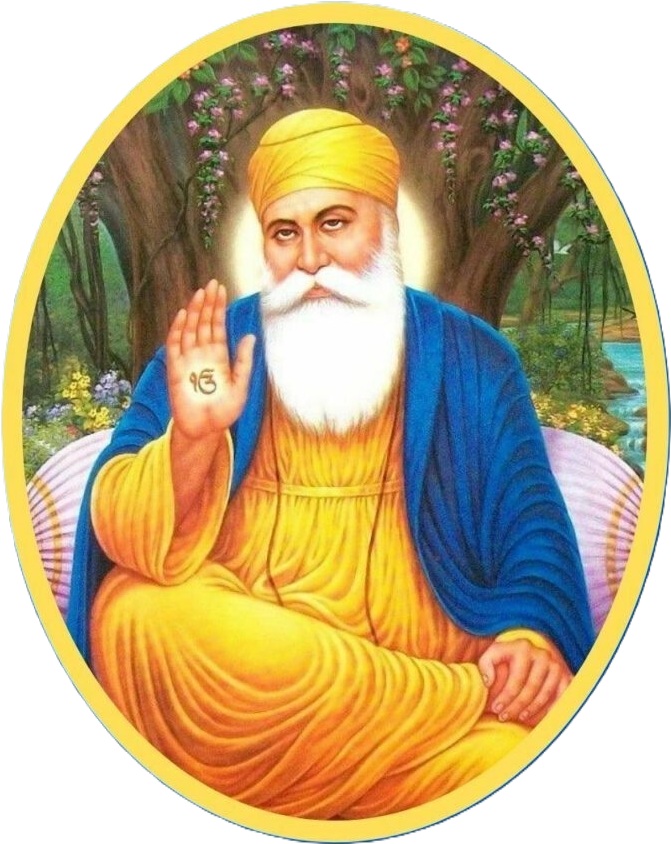
Guru Nanak Dev Ji
Founder of the Sikh faith, who proclaimed Ik Onkar: there is but One Creator of all.
- Parkash
- 15 April 1469 (Vaisakh Sudi 3, Samvat 1526; traditionally celebrated on Katak Puranmashi, the full moon of Kartik)
Rai Bhoi di Talwandi, now Nankana Sahib, Sheikhupura district, Punjab, present-day Pakistan - Gurgaddi
- Founder of the Sikh faith (traditional date of divine commission: 1499, after the revelation at Sultanpur Lodhi)
Sultanpur Lodhi, on the banks of the Kali Bein rivulet - Joti Jot
- 22 September 1539 (Asu Vadi 10, Samvat 1596). Note: the Encyclopaedia of Sikhism and some older sources give 7 September 1539.
Kartarpur Sahib, on the right bank of the river Ravi (Narowal district, present-day Pakistan) - Guruship
- 1469–1539 (Founder; publicly preaching from c. 1499)
Jeevni (Life Story)
Guru Nanak Dev Ji, the First Master and founder of the Sikh faith, took Parkash in 1469 at Rai Bhoi di Talwandi, a village some sixty-five kilometres west of Lahore now revered as Nankana Sahib. His father, Mehta Kalyan Das Bedi, affectionately known as Mehta Kalu Ji, served as patwari to the local Muslim landlord Rai Bular Bhatti; his mother was Mata Tripta Ji, a woman of deep piety. Guru Ji's elder sister, Bebe Nanaki Ji, was the first to recognise the divine light in her brother and remained his most devoted companion. According to tradition, the family midwife Daultan reported that the infant laughed rather than cried at birth, and the astrologer Pandit Hardyal declared that a great soul had come to be revered by Hindus and Muslims alike. The Sikh Panth traditionally celebrates the Parkash Purab on Katak Puranmashi, the full moon of Kartik, though the janamsakhis and modern scholars place the birth in Vaisakh, corresponding to 15 April 1469.
From childhood Guru Nanak Dev Ji displayed a contemplative nature far beyond his years. Sent to Pandit Gopal to learn the vernacular, then to Pandit Brij Nath for Sanskrit and to Maulvi Qutub-ud-Din for Persian and Arabic, the young Nanak astonished each teacher by turning the lessons toward the One Creator, composing the acrostic hymn Patti Likhi on the letters of the alphabet. When his father arranged the janeu ceremony, the boy declined the sacred thread, asking for a thread spun of compassion and contentment, knotted with continence and truth, that would neither break nor burn. Sent to graze cattle, he was found absorbed in meditation while a cobra shaded his face from the sun, an episode witnessed by Rai Bular, who became a devoted protector and later gifted land to the Guru's family. Given twenty rupees to make a profitable trade, young Nanak fed a band of hungry ascetics and returned declaring that he had made the true bargain, the Sacha Sauda. Mehta Kalu Ji despaired, but Bebe Nanaki Ji and Rai Bular understood.
In 1487 Guru Ji was married at Batala to Mata Sulakhani Ji, daughter of Bhai Mul Chand Chona of Pakhoke; the Gurdwaras Kandh Sahib and Dera Sahib at Batala preserve the memory of the wedding. Two sons were born to them: Baba Sri Chand Ji in 1494, who later founded the Udasi order, and Baba Lakhmi Das Ji in 1497. Around 1487 Guru Ji moved to Sultanpur Lodhi, where Bebe Nanaki Ji lived with her husband Bhai Jai Ram Ji, steward to Nawab Daulat Khan Lodhi, governor of the Punjab. Guru Ji was appointed keeper of the Nawab's modikhana, the government granary and store, and discharged his duties with scrupulous honesty, giving generously to the poor from his own wages. Here Bhai Mardana Ji, a Muslim minstrel of the Mirasi caste from Talwandi, ten years older than Guru Ji, joined him permanently; Guru Ji taught him to play the rabab and together they sang the praises of the Lord every morning and evening, drawing a growing circle of seekers.
One morning around 1499, Guru Ji went as usual to bathe in the Kali Bein rivulet and did not return. His clothes were found on the bank and he was given up as drowned. On the third day he reappeared, and remained silent for a day before uttering the words that became the cornerstone of the faith: 'Na koi Hindu, na koi Musalman', there is no Hindu, there is no Musalman, meaning that in the eyes of the Creator all are one humanity. The janamsakhis record that in those three days Guru Ji was summoned to the Divine Court, given the cup of Naam to drink, and charged to go into the world to teach the remembrance of the Name, charity, ablution, service and prayer. The Mool Mantar, Ik Onkar Sat Naam Karta Purakh, which opens Sri Guru Granth Sahib, dates from this revelation. Guru Ji resigned his post, gave away his possessions, and with Bhai Mardana Ji set out as a wandering teacher, wearing a dress that belonged to neither Hindu ascetic nor Muslim faqir.
For the next two decades Guru Nanak Dev Ji travelled farther than perhaps any religious teacher of his age, on the four Udasis that carried him east to Assam and Puri, south to Sri Lanka, north into Tibet and west to Mecca, Medina and Baghdad. Everywhere he went he spoke in the tongue of the common people, sang hymns to the accompaniment of Bhai Mardana Ji's rabab, and challenged hypocrisy with gentle wit and fearless truth. At Saidpur he blessed the humble carpenter Bhai Lalo Ji and exposed the exploitation of Malik Bhago by squeezing milk from Lalo's coarse bread and blood from Bhago's rich fare. At Haridwar he threw water westward toward his fields at Kartarpur, asking the pilgrims how water they tossed toward the sun could reach their ancestors if his could not reach a few hundred miles. At Mecca, when reproached for sleeping with his feet toward the Kaaba, he asked that his feet be turned to wherever God was not. At Hasan Abdal he humbled the proud Wali Qandhari, and at Mount Sumer he debated the Siddhas, who asked him how the world fared below; Guru Ji replied that truth had grown scarce because those who should have guided it had fled to the mountains. In every place he left behind small Sangats, communities of seekers who met to sing the Divine Name.
Returning to the Punjab around 1521, Guru Ji witnessed the horror of Babur's third invasion, when Saidpur was sacked and its inhabitants slaughtered or enslaved. Guru Ji and Bhai Mardana Ji were taken among the captives and set to grinding corn. Tradition records that Babur himself came to see the faqir whose mill turned of its own accord, and, moved by Guru Ji's fearless speech, released the prisoners. The four hymns known as the Babar Vani record Guru Ji's anguish at the suffering of the people and his rebuke to rulers who forget that they too must answer to the Lord: 'Khurasan khasmana kia Hindustan daraia', Having seized Khurasan, Babur has terrified Hindustan. Here Guru Ji showed that the spiritual path does not turn away from the sorrows of the world but bears witness against oppression, a principle that would shape the Sikh Panth for centuries.
About 1522 Guru Ji laid aside the traveller's garb and settled on the right bank of the river Ravi, where a devotee named Karoria offered land for a new township. Guru Ji named it Kartarpur, the Abode of the Creator, and there he lived as a farmer and householder with Mata Sulakhani Ji and his aged parents, demonstrating that the highest spirituality is lived in the midst of work and family. At Kartarpur the first Sikh community took institutional shape: the dharamsal where the Sangat gathered morning and evening to sing Japji Sahib, Asa di Var and Sodar; the Pangat, where all sat in one row to eat regardless of caste; and the Langar, the free kitchen that fed every visitor. Guru Ji composed many of his greatest hymns here, including the Japji Sahib in its final form, and the practice of Kirtan and daily Nitnem was established. Disciples came from across the Punjab, among them Bhai Buddha Ji of Kathu Nangal, a boy of such gravity that Guru Ji called him Buddha, the old wise one, and who would live to anoint six successive Gurus.
Around 1532 a devotee of the goddess Durga from Khadur, Bhai Lehna Ji, heard Guru Nanak Dev Ji's hymns sung by Bhai Jodha and came to Kartarpur on his way to the annual pilgrimage to Jwalamukhi. He never completed that pilgrimage; from that day he placed himself wholly at the Guru's service. Bhai Lehna Ji's devotion was tested again and again: he carried a bundle of mud-soaked grass on his head so that his fine clothes were ruined, retrieved a bowl from a filthy ditch at midnight, and accepted every command without question, where the Guru's own sons hesitated. Baba Sri Chand Ji had chosen the path of asceticism and Baba Lakhmi Das Ji that of worldly affairs; neither, Guru Ji judged, could carry the mission of the householder's path he had founded. In September 1539 Guru Ji placed five paise and a coconut before Bhai Lehna Ji, bowed to him, and had Baba Buddha Ji apply the tilak of Guruship, giving him the name Angad, 'of my own limb'. Guru Angad Dev Ji was sent to Khadur to carry on the work.
On Asu Vadi 10, Samvat 1596, corresponding to 22 September 1539, Guru Nanak Dev Ji merged into the Divine Light at Kartarpur, having instructed the Sangat to sing the Sohila and remain in the remembrance of the Name. Tradition relates that his Hindu and Muslim devotees each claimed the right to perform the last rites, the former by cremation and the latter by burial; when the sheet covering the body was lifted at dawn, only fresh flowers remained, which the two communities divided between them. A samadh and a mazar were raised side by side on the bank of the Ravi, and Gurdwara Darbar Sahib Kartarpur stands there today. Thus, even in his departure, Guru Nanak Dev Ji taught the unity of humanity under the One Creator, and the Light he kindled passed undimmed into Guru Angad Dev Ji and the eight Gurus who followed, until it came to rest eternally in Sri Guru Granth Sahib.
Journeys
Guru Nanak Dev Ji undertook four great missionary journeys, the Udasis, between about 1500 and 1521, accompanied for most of the way by Bhai Mardana Ji, the Muslim rababi of Talwandi, who played the rabab while Guru Ji sang his hymns. The first Udasi (c. 1500–1506) went eastward: at Saidpur (Eminabad) Guru Ji chose the humble meal of the carpenter Bhai Lalo Ji over the feast of the corrupt official Malik Bhago; at Talumba he transformed the robber Sajjan into a saint; at Haridwar he threw water westward toward his fields to show the futility of offering water to ancestors; at Kurukshetra he taught during the solar eclipse fair; he visited Delhi, Banaras (where he discoursed with Pandit Chatur Das), Gaya, Patna, Kamrup in Assam, Dhaka and Jagannath Puri, where he sang the Aarti, 'Gagan mai thaal rav chand deepak bane', declaring the whole cosmos to be the true worship of the Lord. The second Udasi (c. 1506–1513) went south through Rajputana, Ujjain, the Deccan and Rameswaram to Sri Lanka, where Raja Shivnabh became a devotee and a Sangat was established; Guru Ji returned via Bidar and Gujarat. The third Udasi (c. 1514–1518) went north into the Himalayas: Kashmir, Ladakh, Tibet and Mount Sumer (Kailash), where the Sidh Gosht records his dialogue with the Siddhas, then Nepal and Sikkim. The fourth Udasi (c. 1519–1521) went west to the heart of the Islamic world: through Multan and Uch to Mecca, where Guru Ji is remembered for teaching that God's house lies in every direction, then Medina and Baghdad, where he conversed with Pir Dastgir and Pir Bahlol, then Persia, Kabul and Kandahar, returning through Hasan Abdal (Panja Sahib, where the stone of Wali Qandhari bears the imprint of his palm) and Peshawar. Shorter journeys took Guru Ji to Pakpattan, where he met Sheikh Ibrahim (Farid Sani), the successor of Baba Farid, and to Achal Batala and Multan, where he met the Nath yogis and Sufi pirs. Returning to Punjab around 1521, Guru Ji witnessed the devastation of Saidpur by Babur's army, and finally settled at Kartarpur on the Ravi.
Teachings
Guru Nanak Dev Ji taught that there is One Creator, Ik Onkar, who is Truth itself (Sat Naam), without fear and without enmity, beyond birth and death, self-existent and realised by the grace of the Guru. The whole of creation is the Lord's manifestation, and every human being, whatever caste, creed or gender, carries the same Divine Light; Guru Ji therefore rejected caste pride, the subjugation of women, idol worship, empty ritual, pilgrimage for show, and the pretensions of priests and ascetics. He placed the householder's life at the centre of spirituality, summing up the Sikh way in three pillars: Naam Japna, constant remembrance of the Divine Name; Kirat Karni, earning an honest living by one's own labour; and Vand Chhakna, sharing one's earnings with the needy. Truth is high, he said, but higher still is truthful living. Liberation comes not by renunciation but by surrender of ego (haumai) to the Divine Will (Hukam), through loving devotion, service (seva) and the company of the holy (Sangat). The Japji Sahib opens Sri Guru Granth Sahib with his vision of the Hukam that pervades all, and its closing salok reminds the seeker that those who have meditated on the Name depart with honour, and many are liberated in their company.
Timeline
-
1469
Parkash of Guru Nanak Dev Ji at Rai Bhoi di Talwandi (Nankana Sahib) to Mehta Kalu Ji and Mata Tripta Ji; traditional celebration on Katak Puranmashi (15 April by the modern reckoning).
-
1475–1478
Sent to the village school of Pandit Gopal and later to Pandit Brij Nath and Maulvi Qutub-ud-Din; composed the acrostic Patti Likhi and astonished teachers with questions about the One Creator.
-
c. 1478–1480
Declined to wear the janeu (sacred thread) at the ceremony arranged by his father, teaching that true adornment is compassion, contentment and truth.
-
c. 1483
The Sacha Sauda: given twenty rupees to trade, Guru Ji fed hungry ascetics near Chuharkana, calling it the true bargain; Rai Bular Bhatti became a lifelong devotee.
-
1487
Marriage to Mata Sulakhani Ji, daughter of Bhai Mul Chand of Batala, at Batala (Gurdwara Kandh Sahib and Dera Sahib commemorate the event).
-
c. 1487–1488
Moved to Sultanpur Lodhi at the invitation of Bebe Nanaki Ji and Bhai Jai Ram Ji; employed as keeper of the modikhana (storehouse) of Nawab Daulat Khan Lodhi; Bhai Mardana Ji joined him as companion and rababi.
-
1494
Birth of Baba Sri Chand Ji; Baba Lakhmi Das Ji was born in 1497.
-
1499
At the Kali Bein at Sultanpur Lodhi, Guru Ji disappeared into the waters for three days; he emerged with the divine commission and uttered the Mool Mantar, declaring 'There is no Hindu, there is no Musalman'.
-
1500–1506
First Udasi to the east: Saidpur (Eminabad), Talumba, Kurukshetra, Haridwar, Delhi, Banaras, Gaya, Patna, Kamrup (Assam), Dhaka, Jagannath Puri and back through central India.
-
1506–1513
Second Udasi to the south: through Rajputana and the Deccan to Rameswaram and Sri Lanka, where Raja Shivnabh of Jaffna became a disciple; return via Bidar and Baroach.
-
1514–1518
Third Udasi to the north: Kashmir, Ladakh, Tibet, Mount Sumer (Kailash and Mansarovar), Nepal and Sikkim; the Sidh Gosht dialogue with the Siddhas.
-
1519–1521
Fourth Udasi to the west: Multan, Uch, Mecca, Medina, Baghdad, Persia, Kabul, Kandahar and Hasan Abdal (Panja Sahib), returning through Peshawar and Saidpur.
-
1520–1521
Witnessed the sack of Saidpur by Babur's army; Guru Ji and Bhai Mardana Ji were taken among the captives; the Babar Vani hymns were composed and Babur ordered the prisoners released.
-
c. 1522
Settled at Kartarpur on the river Ravi, founded on land offered by devotee Karoria (Duni Chand); Guru Ji took up farming and established Sangat, Pangat and Langar.
-
c. 1532
Bhai Lehna Ji of Khadur came to Kartarpur and dedicated himself wholly to the service of Guru Ji.
-
c. 1534
Bhai Mardana Ji, lifelong companion and first rababi, departed this world at Kurram (Afghanistan) while journeying with Guru Ji, according to tradition.
-
1539
7 September: After testing his sons and disciples, Guru Ji installed Bhai Lehna Ji as Guru Angad Dev Ji, placing five paise and a coconut before him while Baba Buddha Ji applied the tilak of Guruship.
-
1539
22 September (Asu Vadi 10, Samvat 1596): Guru Nanak Dev Ji merged into the Divine Light (Joti Jot) at Kartarpur Sahib; Hindu and Muslim devotees alike claimed the honour of the last rites, finding only flowers beneath the sheet.
Legacy
Guru Nanak Dev Ji is revered by Sikhs as Jagat Guru, the Guru of the whole world, and his message of one God and one humanity continues to draw millions to the Sikh path and countless others to honour him. The 974 hymns he composed form the foundation of Sri Guru Granth Sahib, and the Japji Sahib he gave is recited every dawn by Sikhs across the globe. The institutions he founded at Kartarpur, the Sangat, Pangat and Langar, grew into the universal free kitchens that today feed millions daily without distinction of faith or status. His nine successors described themselves as bearers of the same light, so that the whole Sikh tradition, from Guru Angad Dev Ji's Gurmukhi script to Guru Gobind Singh Ji's Khalsa, is understood as the unfolding of Guru Nanak's mission. Nankana Sahib, Sultanpur Lodhi, Kartarpur Sahib, Panja Sahib and the shrines along his Udasis remain places of pilgrimage, and the opening of the Kartarpur Corridor in November 2019, during the 550th Parkash Purab celebrations, allowed pilgrims from India to pay homage at the place of his Joti Jot. Bhai Gurdas Ji summed up his advent in the words: 'Satgur Nanak pargatia, miti dhund jag chanan hoa', with the appearance of the True Guru Nanak, the mist cleared and the world was filled with light.