Sri Guru Granth Sahib Ji
The eternal Shabad Guru: the living Word that guides the Khalsa Panth for all time
- Parkash
- First Parkash of the Adi Granth at Sri Harmandir Sahib on 1 September 1604 (Bhadon Sudi 1, Samvat 1661); observed on 1 September (17 Bhadon) in the Nanakshahi calendar
Sri Harmandir Sahib, Amritsar, with Baba Buddha Ji as the first Granthi - Gurgaddi
- 6 October 1708 (Katak Sudi 2, Samvat 1765), bestowed by Sri Guru Gobind Singh Ji; observed on 20 October in the Nanakshahi calendar
Nanded (Abchal Nagar), on the Godavari - Takht Sachkhand Sri Hazur Sahib - Guruship
- 1708 to eternity
Jeevni (Life Story)
Sri Guru Granth Sahib Ji is the eternal Guru of the Sikhs - not a book about the Guru, but the Guru itself, the embodied Shabad in which the light of the ten Masters lives. Its story begins with Sri Guru Nanak Dev Ji, whose hymns, composed in the course of his travels between 1499 and 1539, were recorded in a pothi that he passed to Sri Guru Angad Dev Ji together with the Gurgaddi. The Second Master gave the Gurmukhi script its settled form, and the Third Master, Sri Guru Amar Das Ji, added his own bani and had the collection, together with hymns of the Bhagats that had come into the Gurus' possession, preserved in volumes kept at Goindwal; these Goindwal or Mohan Pothis were in the keeping of his son Baba Mohan Ji. Sri Guru Ram Das Ji added his hymns in turn. By the time of the Fifth Master the corpus of authentic bani had grown large, while imitators - among them the Minas, followers of Prithi Chand - were circulating compositions of their own under the Gurus' name. Sri Guru Arjan Dev Ji resolved to fix the Word of the Gurus in a single authoritative volume.
Guru Arjan Dev Ji chose for the work a secluded spot by a pool to the south of Amritsar, now called Ramsar, and had a tent pitched there. Bhai Gurdas Ji, the scholar and poet who was the Guru's maternal uncle's son and the most trusted Sikh of the age, served as scribe. The Goindwal Pothis were brought from Baba Mohan Ji - tradition records that the Guru went himself to Goindwal and sang the hymn 'Mohan tere uche mandar' beneath the saint's window until he came down and gave them with blessing - and Sikhs were sent to collect genuine bani from the sangats. Guru Sahib sifted every composition, rejecting those not in accord with the Gurus' teaching, and arranged the whole in an order of extraordinary beauty: first the Mool Mantar and Japji Sahib, then the hymns for evening and night, then the body of the scripture divided by Raag, and within each Raag the hymns of the Gurus in order from Mahala 1 to Mahala 5, each Guru signing himself 'Nanak', followed by the longer compositions and then the bani of the Bhagats. The work took about three years, from roughly 1601 to 1604, and Guru Sahib composed many of his own hymns, including Sukhmani Sahib, in the course of it. Guru Sahib's own share - over 2,200 hymns - is the largest in the Granth.
The compilation was completed in the summer of 1604 and on 1 September 1604 (Bhadon Sudi 1, Samvat 1661) the Adi Granth was carried in procession from Ramsar to Sri Harmandir Sahib, Baba Buddha Ji bearing the volume on his head and Guru Arjan Dev Ji walking behind with the chaur. It was installed on a raised platform in the centre of the shrine, and Baba Buddha Ji, appointed the first Granthi, opened it at random and read the first Hukamnama: 'Santa ke karaj aap khaloia, Har kam karavan aia Ram' - the Lord Himself has stood up to accomplish the task of His saints (Raag Soohi, Ang 783). That night Guru Arjan Dev Ji slept on the floor beside the Granth, setting the standard of reverence that Sikhs have followed ever since. Two years later Guru Sahib attained Shaheedi at Lahore, and the Granth passed into the care of Sri Guru Hargobind Sahib Ji at Amritsar. When the Sixth Master moved to Kiratpur, the volume remained in the hands of his grandson Dhir Mal at Kartarpur in the Jalandhar Doab, and his descendants, the Sodhis of Kartarpur, hold it to this day as the Kartarpuri Bir. Guru Tegh Bahadur Ji, when his Sikhs seized it from Dhir Mal's men in 1664, returned it without hesitation; scholars who have examined it, notably Bhai Jodh Singh in 1945, have described a volume with the marginal notes and corrections of the scribe and the Nishan (Mool Mantar in the Guru's hand) of Guru Arjan Dev Ji and Guru Hargobind Sahib Ji.
The Adi Granth received its final form a century after its compilation. Sri Guru Gobind Singh Ji, resting at Talwandi Sabo in the Malwa in 1705 and 1706 after the battles of Anandpur, Chamkaur and Muktsar, had Bhai Mani Singh Ji write out the whole Granth afresh, Guru Sahib dictating the text from memory, and inserted in its proper places the bani of his father, Sri Guru Tegh Bahadur Ji - 59 shabads in 15 Raags and 57 saloks, the Salok Mahala 9 being placed near the close of the volume. One salok of the Ninth Master, 'Bal hoa bandhan chhute', is held by many to have been completed by Guru Gobind Singh Ji himself, who otherwise included none of his own compositions. Talwandi Sabo became known as Damdama Sahib, the place of rest, and as Guru Ki Kashi, the Guru's seat of learning, and the volume prepared there as the Damdami Bir. It is this text, closed with Mundavani - the seal of Guru Arjan Dev Ji declaring that the platter holds the three things of Truth, Contentment and Contemplation - that the Sikhs hold as the authorised Sri Guru Granth Sahib Ji. The original Damdami Bir accompanied Guru Sahib to the Deccan and is believed to have been lost in the Vadda Ghallughara of 1762, but its text was already preserved in many copies.
In its standard printed form Sri Guru Granth Sahib Ji has 1430 Angs (the Sikhs say Ang, limb, rather than page, in deference to the Guru's living body), and every printed saroop in the world has the same text on the same Ang. The first thirteen Angs contain the Mool Mantar and Japji Sahib of Guru Nanak Dev Ji, followed by So Dar and So Purakh (the core of the evening Rehras) and the Sohila for night. Angs 14 to 1352 are arranged under 31 Raags: Sri Raag, Majh, Gauri, Asa, Gujri, Devgandhari, Bihagra, Vadhans, Sorath, Dhanasri, Jaitsri, Todi, Bairari, Tilang, Suhi, Bilaval, Gond, Ramkali, Nat Narayan, Mali Gaura, Maru, Tukhari, Kedara, Bhairo, Basant, Sarang, Malar, Kanra, Kalyan, Prabhati and Jaijavanti. Within each Raag the shabads of the Gurus come first in order of succession, then the ashtpadis, chhants and vaars, and then the Bhagat bani. After the Raag section come the Salok Sahaskriti, Gatha, Phunhe, Chaubole, the saloks of Bhagat Kabir Ji and Sheikh Farid Ji, the Savaiye of the Bhatts in praise of the Gurus, the Salok Varan te Vadhik, the Salok Mahala 9, Mundavani with the final salok of Guru Arjan Dev Ji, and the Raagmala, a catalogue of Raags, on Ang 1430. The whole contains nearly six thousand hymns.
Thirty-six voices speak in Sri Guru Granth Sahib Ji. Six of them are Gurus: Guru Nanak Dev Ji, Guru Angad Dev Ji, Guru Amar Das Ji, Guru Ram Das Ji, Guru Arjan Dev Ji and Guru Tegh Bahadur Ji, each signing himself Nanak and distinguished in the headings as Mahala 1 to 5 and 9. Fifteen are Bhagats, saints of the medieval Bhakti and Sufi movements from across India and across the centuries: Sheikh Farid Ji of Pakpattan, Bhagat Kabir Ji and Bhagat Ravidas Ji of Banaras, Bhagat Namdev Ji and Bhagat Trilochan Ji of Maharashtra, Bhagat Jaidev Ji of Bengal, Bhagat Beni Ji, Bhagat Dhanna Ji of Rajasthan, Bhagat Pipa Ji, Bhagat Sain Ji, Bhagat Sadhna Ji of Sindh, Bhagat Bhikhan Ji, Bhagat Ramanand Ji, Bhagat Parmanand Ji and Bhagat Surdas Ji. Eleven are Bhatts, the bards who sang the glory of the Gurus at the court of Guru Arjan Dev Ji: Kalsahar, Jalap, Kirat, Bhikha, Salh, Bhalh, Nalh, Gayand, Mathura, Bal and Harbans. Four are Gursikhs from the Gurus' own households: Bhai Mardana Ji, the lifelong companion of Guru Nanak Dev Ji; Baba Sundar Ji, great-grandson of Guru Amar Das Ji, whose Sadd describes the Third Master's passing; and the rababis Rai Balwand and Satta Doom, whose vaar celebrates the first five Gurus. No other scripture in the world gathers the words of so many traditions, castes and regions as the Word of one God.
The language of Sri Guru Granth Sahib Ji is as inclusive as its authorship. The Gurus wrote chiefly in the Punjabi of their day, enriched with the Sant Bhasha that saints across northern India shared - a blend of Braj, Khari Boli and Awadhi - and with words of Persian, Arabic, Sindhi, Sanskrit and Marathi; Guru Nanak Dev Ji composed hymns in Persian idiom in Raag Tilang, Guru Arjan Dev Ji wrote the Sahaskriti saloks in a Sanskritised tongue, and the Bhagats speak in the dialects of their homelands. The whole is written in the Gurmukhi script, which the Gurus made the vehicle of their Word and which has carried the Punjabi language ever since. The original volumes were written larivaar, with the words joined in continuous lines, as the Kartarpuri Bir still is, and many saroops are still written and printed in this form; pad-chhed editions with separated words appeared in the nineteenth and twentieth centuries to aid readers. Every hymn is set to a Raag, so that Gurbani is meant to be sung, and the Kirtan of Sri Harmandir Sahib has carried the melodies of the Granth unbroken for four hundred years.
On 6 October 1708 (Katak Sudi 2, Samvat 1765), at Nanded on the Godavari, Sri Guru Gobind Singh Ji, knowing that his earthly days were ending, had the Granth installed in his presence, placed before it the coconut and five paise that had marked every succession since Guru Nanak Dev Ji, circled it, bowed, and declared to the assembled Khalsa that the Granth was henceforth their Guru. The words are preserved in the Sikh tradition: 'Agya bhai Akal ki tabhi chalayo Panth, Sab Sikhan ko hukam hai Guru manyo Granth; Guru Granth Ji manyo pargat Guran ki deh, Jo Prabh ko milbo chahai khoj shabad mein leh' - By the command of the Timeless One the Panth was created; all Sikhs are commanded to accept the Granth as Guru; know the Guru Granth as the visible body of the Gurus; whoever would meet the Lord, let him seek Him in the Shabad. The line of human Gurus was closed. The Guru's spirit was to live in the Shabad, the Granth, and the Guru's body in the Khalsa Panth gathered in its presence; the two together, Guru Granth and Guru Panth, were to guide the Sikhs for all time. The next day Guru Gobind Singh Ji merged with the Divine Light.
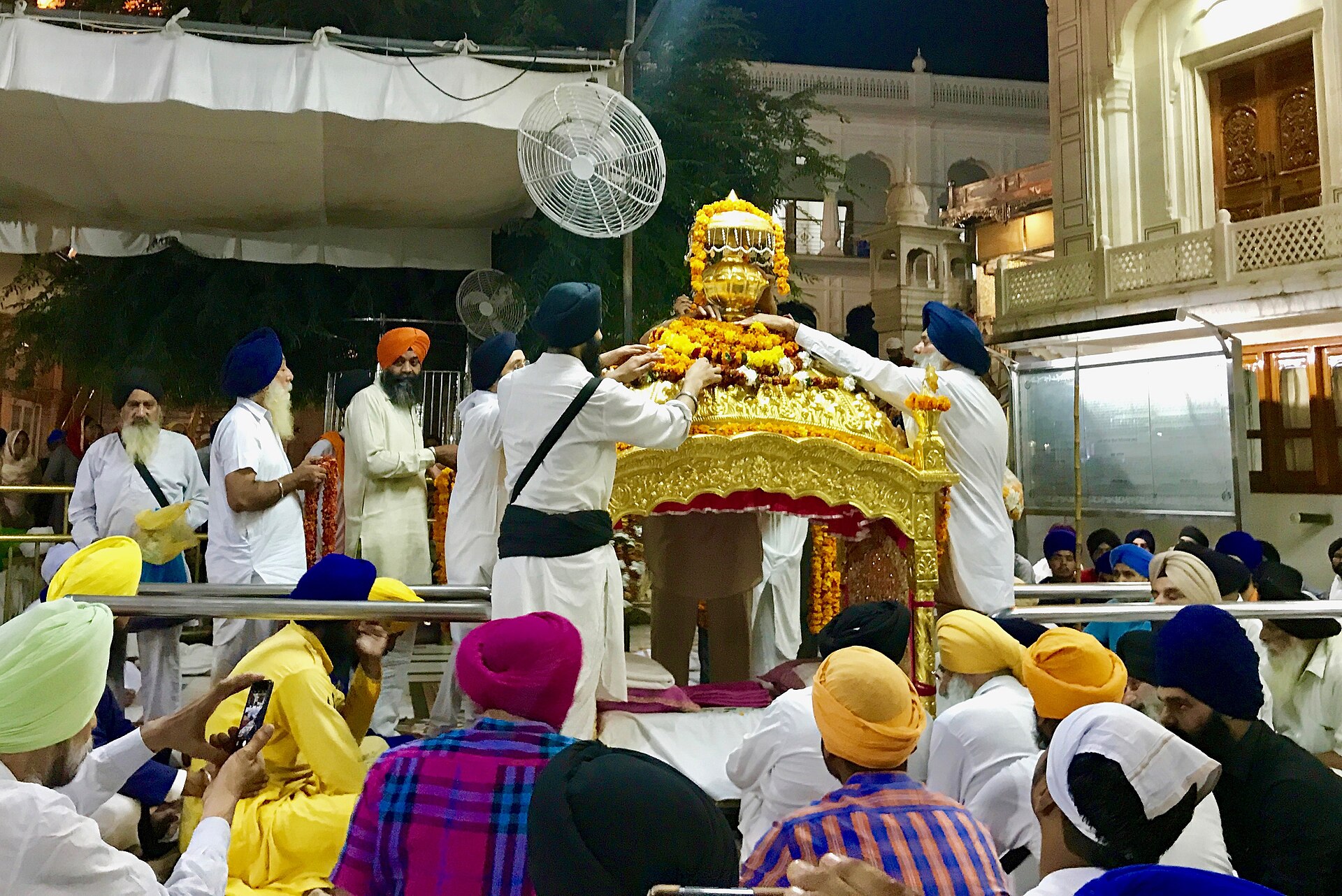
From that day Sri Guru Granth Sahib Ji has been the centre of Sikh life. Every Gurdwara exists to house the Guru: the saroop is installed each morning (Parkash) on a raised throne (Manji Sahib) beneath a canopy (Chanani or Palki), wrapped in rumalas, with a chaur waved over it, and is laid to rest each night (Sukhasan) in a separate room, the Sachkhand. From Sri Harmandir Sahib each dawn a Hukamnama is read at random from the Guru and sent to the world as the Guru's command for the day; every Gurdwara takes its own Hukamnama, and every Sikh ceremony - the naming of a child from the first letter of the Hukamnama, the Amrit Sanchar, the Anand Karaj in which the couple circle the Guru four times to the Lavan of Guru Ram Das Ji, and the Antim Ardas at death - takes place in the Guru's presence. The Akhand Path, an unbroken reading of the whole Granth by relays of readers over about forty-eight hours, marks every solemn occasion; the Sahaj Path is a reading completed at leisure, and the Sadharan or Sampat Paths have their own forms. The Ardas is always concluded before the Guru, and the Karah Parshad distributed after it. Sikhs remove their shoes, wash their hands, cover their heads and bow with the forehead to the ground before the Guru, sit below its level, and never turn their backs to it; no one may sit on a seat higher than the Guru in its presence, no tobacco or intoxicant may be brought near, and the saroop is carried only on the head and under escort. Since the Gurdwara Reform movement the Shiromani Gurdwara Parbandhak Committee alone prints saroops, so that the text remains uniform in every Gurdwara in the world, and worn saroops are not discarded but given Agan Bhet, cremation with full honour, at Goindwal Sahib.
The Sikhs do not regard Sri Guru Granth Sahib Ji as a holy book to be venerated from a distance but as the living presence of their Guru, who speaks to each one who comes with faith. Its hymns are sung at dawn and dusk in every Gurdwara, memorised by children, read in the Nitnem of every Sikh home, and heard in the Kirtan that has never ceased at Sri Harmandir Sahib. Scholars of every faith have found in it a scripture of rare universality - the Sikh Gurus gave the words of a Muslim Sufi and a low-caste cobbler the same honour as their own - and translations into English, Hindi, Urdu, French, German, Spanish and many other languages have carried its message far beyond the Punjab. For the Sikh, however, no translation can replace the Guru: the Gurmukhi Word in Raag, received with reverence and lived with love, is the Guru Nanak Dev Ji who still walks with the Panth, the Guru Gobind Singh Ji who still commands it, and the Timeless One whose praise it sings on every Ang.
Journeys
Sri Guru Granth Sahib Ji is the Guru who has travelled with the Sikhs wherever they have gone. The Adi Granth compiled at Ramsar was carried in procession to Sri Harmandir Sahib in 1604, with Baba Buddha Ji bearing it on his head and Guru Arjan Dev Ji walking behind waving the chaur. The original volume, the Kartarpuri Bir, went with Dhir Mal to Kartarpur in the Jalandhar Doab, where it remains. Guru Gobind Singh Ji's Damdami Bir was prepared at Talwandi Sabo in the Malwa and accompanied him on the long road through Rajasthan and the Deccan to Nanded, where it received the Gurgaddi. In the eighteenth century saroops of the Granth rode in the saddlebags of the Khalsa and were hidden in the forests of the Lakhi Jungle and the hills of Kahlur; in the nineteenth it was installed in the gilded Harmandir Sahib and in Gurdwaras from Peshawar to Patna, and in the twentieth and twenty-first it has crossed the oceans with the Sikh diaspora to Gurdwaras in every continent, always carried on the head, under a canopy, with the same reverence Baba Buddha Ji showed in 1604. Every day at Sri Harmandir Sahib the Guru's saroop is carried in a golden palki from Sri Akal Takht Sahib at dawn and returned at night, the oldest and most continuous of all Sikh processions.
Teachings
Sri Guru Granth Sahib Ji opens with Ik Oankar - the One Creator, Truth by Name, the Creator Being, without fear, without enmity, timeless in form, unborn, self-existent, realised by the Guru's grace - and every one of its 1430 Angs unfolds this Mool Mantar. It teaches that the Lord is one, present in all creation and in every heart; that He is to be remembered through Naam Simran and praised through Kirtan; that the ego (haumai) is the wall between the soul and its source, and that it falls through the Guru's Shabad, through humility, honest work (kirat), sharing with others (vand chhakna) and the company of the holy (sadh sangat). It rejects caste, idolatry, empty ritual, asceticism for its own sake and the subjection of women, and it calls the Sikh to live as a householder in the world while remaining detached within, like the lotus in the water. It addresses every human being, Hindu and Muslim, high and low, and includes the voices of a Muslim Sufi (Sheikh Farid Ji), a weaver (Kabir Ji), a cobbler (Ravidas Ji), a calico-printer (Namdev Ji), a farmer (Dhanna Ji) and a butcher (Sadhna Ji) beside those of the Gurus, teaching by its very structure that truth knows no caste. Its message is summed up in its own words: 'Truth is high, but higher still is truthful living' (Sri Raag, Ang 62).
Timeline
-
1469–1539
Sri Guru Nanak Dev Ji composes his bani during his lifetime and travels; the pothi of his hymns passes to Sri Guru Angad Dev Ji with the Gurgaddi in 1539.
-
1539–1574
Guru Angad Dev Ji develops the Gurmukhi script and Guru Amar Das Ji adds his own bani; the collection is preserved in the Goindwal Pothis (Mohan Pothis) kept by Baba Mohan Ji at Goindwal.
-
1574–1581
Sri Guru Ram Das Ji composes his hymns, including the Lavan, and the corpus grows.
-
c. 1601–1604
Sri Guru Arjan Dev Ji, seated at Ramsar near Amritsar, compiles the Adi Granth with Bhai Gurdas Ji as scribe, drawing on the Goindwal Pothis obtained from Baba Mohan Ji and on collections brought by Sikhs; the bani of the Bhagats and Bhatts is selected and arranged by Raag.
-
1604
First Parkash of the Adi Granth at Sri Harmandir Sahib on 1 September (Bhadon Sudi 1); Baba Buddha Ji is appointed the first Granthi and reads the first Hukamnama, 'Santa ke karaj aap khaloia' (Raag Soohi, Ang 783). Guru Arjan Dev Ji sleeps on the floor beside the Granth.
-
1606
Shaheedi of Guru Arjan Dev Ji at Lahore; the Adi Granth remains at Amritsar under Guru Hargobind Sahib Ji, and Kirtan of its hymns continues daily at Harmandir Sahib.
-
1644
After Guru Hargobind Sahib Ji's Joti Jot the original volume remains with his grandson Dhir Mal at Kartarpur (Jalandhar); it becomes known as the Kartarpuri Bir and is still held by the Sodhi family there.
-
1664
Guru Tegh Bahadur Ji, attacked and robbed at Bakala by Dhir Mal's agents, returns the recovered Granth to Dhir Mal, declining to claim it by force.
-
1675
Shaheedi of Guru Tegh Bahadur Ji, whose 59 shabads and 57 saloks will be the only bani added to the Adi Granth after 1604.
-
1705–1706
At Talwandi Sabo (Damdama Sahib) Guru Gobind Singh Ji dictates the whole Granth to Bhai Mani Singh Ji, adding Guru Tegh Bahadur Ji's bani in its proper places; this recension is the Damdami Bir, the authorised text of Sri Guru Granth Sahib Ji.
-
1708
At Nanded on 6 October (Katak Sudi 2) Guru Gobind Singh Ji places the coconut and five paise before the Granth, bows, and bestows the Gurgaddi upon it for all time: 'Sab Sikhan ko hukam hai Guru manyo Granth.'
-
1708
Guru Gobind Singh Ji merges with the Divine Light on 7 October; from this day Sri Guru Granth Sahib Ji is the sole Guru of the Sikhs and the Khalsa Panth its body.
-
1708–1799
Through the persecutions of the eighteenth century the Khalsa carries saroops of the Granth into the forests and hills; the Damdami Bir is believed lost in the Vadda Ghallughara of 1762, but copies of its text multiply through handwritten saroops.
-
1799–1849
Under Maharaja Ranjit Singh the Granth is honoured at Harmandir Sahib, now clad in gold, and in the Sikh darbar; Hukamnamas are taken daily and copying by hand flourishes.
-
1864
The first printed (lithographed) edition of the Granth is produced at Lahore; printing gradually replaces handwritten saroops.
-
late 19th and early 20th century
The standard 1430-Ang pagination is fixed and pad-chhed (word-separated) editions appear beside the original larivaar (continuous) form; Sri Guru Granth Sahib Ji becomes the text read in Akhand Paths across the Sikh world.
-
1909–1969
Complete translations appear - M. A. Macauliffe (selections, 1909), Gopal Singh (1960–62) and Manmohan Singh (SGPC, 1962–69) - and Prof. Sahib Singh completes his ten-volume Punjabi exegesis, Sri Guru Granth Sahib Darpan (1962–64).
-
1925 onwards
The Shiromani Gurdwara Parbandhak Committee becomes the custodian of the authorised text; it is today the only body permitted to print saroops of Sri Guru Granth Sahib Ji, and old saroops are given Agan Bhet (cremation) with full honour at Goindwal Sahib.
-
2004
The 400th anniversary of the first Parkash is celebrated across the world; the Sikh Rehat Maryada and the Akal Takht continue to uphold the protocol of reverence for the living Guru.
Legacy
Sri Guru Granth Sahib Ji is the only scripture in the world that is itself a Guru, installed with the full rites of succession by the last human Master and honoured as a living sovereign ever since. For over three centuries it has held the Sikh Panth together without a priesthood or a central human authority: in exile and persecution, under the Sikh kingdom and under foreign rule, in the Punjab and in the diaspora, the Guru's Word has been the one unchanging centre. Its vision of the One God in all creation, of the equality of all human beings, and of truthful living above all ritual has shaped the Sikh ideals of seva, langar and the defence of the oppressed, and its gathering of Hindu, Muslim and Sikh voices in a single Word remains a model of harmony. The Gurmukhi script and the classical Punjabi language rest upon it; the Kirtan tradition of thirty-one Raags is a living treasure of Indian music; and the Hukamnama from Sri Harmandir Sahib is read each morning by millions. Sikhs believe that the light which passed from Guru Nanak Dev Ji through nine successors shines today from the Angs of the Guru Granth, and that whoever seeks the Lord will, as Guru Gobind Singh Ji promised, find Him in the Shabad.